Possibly the best three-bean chilli in the world?

Food & drink
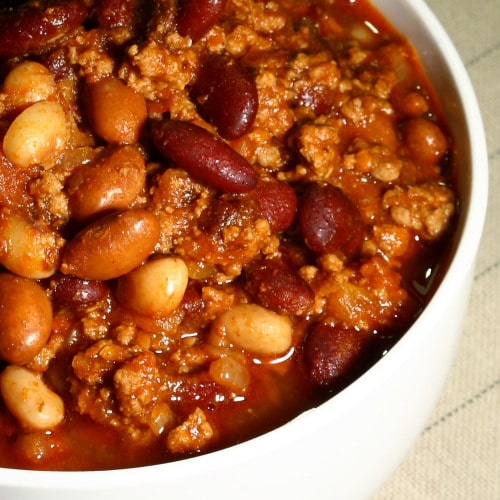
Three bean chilli

I need to point two important things out before I start:

  • everybody does this differently.  This is just my way.  Yours may be better. The title of this post is obviously a provocative lie.
  • I’ve no idea what ‘authentic’ is when it comes to this dish.  Hot? Mild? Beans? No beans?  No idea. This is probably not authentic, but it is quite good.

OK, that’s the disclaimers out of the way.  On to the food.

Chilli recipes vary enormously in method and technique, but they all start with onions and garlic softened in oil.  Three medium onions, chopped finely and about six cloves of garlic, crushed, should be enough.  Keep the heat medium to low, so that the onions and garlic don’t colour too much.

In a separate, large pan, brown a kilo of beef mince, the best quality, leanest you can find.

When the onions are soft, add chilli and continue to cook, slowly and gently.

The amount of chilli to use is entirely subjective.

I used two large dried ancho chillis, steeped in hot water for quarter of an hour and then sliced thinly, along with one similarly reconstituted chipotle.  The anchos are mild, with a smokey flavour of dried fruit and tobacco.  They’re normally stuffed and roasted in Mexico, or pureed to make sauces for enchiladas.  The chipotle is a different beast – fiery hot, vicious with a distinct smell of smoke (a chipotle is a smoked jalapeno pepper).  This is the one that gives the dish its kick.

The onions will take on a different character as the chillis start to cook.  You’ll be able to smell the chilli, the sharp power of the fruits catching the back of the throat.

Next, add some spices.

Toast four teaspoons of cumin seeds and two teaspoons of coriander seeds in a dry frying pan over a medium heat until they start to turn a nutty brown, and then grind them to a powder in a pestle and mortar.

Add the spices to the onions and chillis with two teaspoons each of ground cinnamon and smoked paprika. You can also add some cayenne pepper at this point, for an extra kick, although this is purely optional.

Let the spices cook for a couple of minutes, then deglaze the pan with a cup or so of beef stock. Stock from a stock cube is fine.  Scrape the bottom of the pan thoroughly, stirring all the time, and then add two cans of chopped tomatoes and four tablespoons of tomato puree.

Stir everything together, and then tip the whole lot over the browned mince.

Season with salt and pepper, add a large bay leaf and top up with stock.

Leave the chilli to bubble away on a very low heat, uncovered.  Keep an eye on the level of liquid, and if things start to look too dry, add a splash more stock or water.

After two hours, add some beans kidney, pinto and black eye – soaked and cooked according to the packet’s instructions if you’re using dried, or thoroughly drained and rinsed if you’re using canned.  Use about a kilo of beans in total, maybe three tins.

After another half an hour, add two teaspoons of cocoa powder, or a few chunks of dark chocolate with a very high cocoa content (75% plus).  Combining chilli and chocolate sounds strange, but the two ingredients go very well together.  The chocolate will add the slightest hint of sweetness and a thin layer of bitterness to the finished dish.  South and Central Americans have been doing this for centuries.

Cook for yet another half an hour, adjust the seasoning and serve with rice.

The finished dish is very powerful, especially if you choose your chillis recklessly.  The ancho and chipotle layered a deep rustic taste into the chilli, without the sharp slice you often get from using just chilli powder.  The beans take some of the edge off the heat.

These quantities make a huge amount of chilli, but it freezes well and defrosts quickly over a low heat.  You may as well make a lot in one go and save some for those nights when you just can’t be bothered.

My chillis come from The Cool Chile Company – well worth a quick look.
Could the Nordic Diet stop obesity?

Books, Food politics
Could the Nordic Diet stop obesity? post image

There should be little doubt that Britain has a problem with its’ weight.

Current estimates rate the level of obesity at around a quarter of the population.

That’s a lot of big people.

The traditional British diet, heavy in saturated fats and carbohydrates, added to an ever more sedentary lifestyle would seem to be the cause of the problem.

But what about the solution?

A Mediterranean diet of olive oil, fish, and vegetables has been the cornerstone of ‘healthy eating’ for the last generation, but scientists have noticed that the Scandinavian know the odd thing about healthy eating, too.

A broadly Nordic diet shares many of the same characteristics as that of it’s southern neighbours, replacing olive for rapeseed oil, Mediterranean vegetables for brassicas and citrus fruits for cold climate berries.

The University of Copenhagen is funding a study into regional Scandinavian food aimed at identifying a canon of ingredients to rival the famed Mediterranean diet in terms of nutrition and taste.

The principles of a Nordic diet are simple, based around a few core principles:

  • eat more fish
  • eat less meat, and when you do eat meat, eat lean game meat such as venison
  • brassicas are intrinsically healthy, packed with vitamins and antioxidants.  They can taste good.
  • a couple of meals a week should be vegetarian
  • cut down on saturated fat

It all seems quite sensible.  But does it taste good?

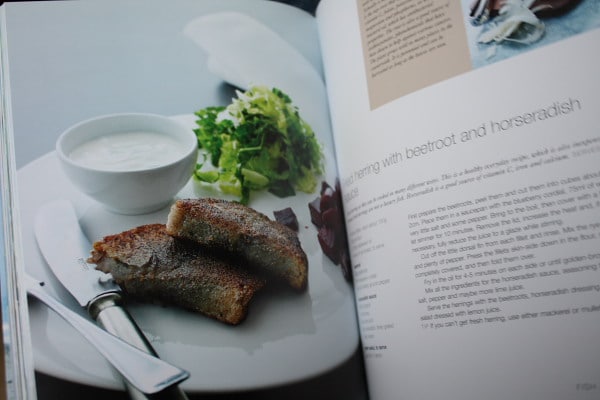
Trina Hahnemann wrote the successful Scandinavian Cookbook in 2008, and follows up with The Nordic Diet, a further collection of Scandinavian recipes masquerading unconvincingly as a diet book.

Hahnemann’s cooking is simple Scandinavian, adapted for the foreign market and palate.  Recipes are simple and bright, with clean, fresh flavours from recognisable and easily obtained ingredients.

Easy Danish smorrebrod, open sandwiches of rye bread topped with herring or salmon, egg, tomato, chervil, dressed with cutting vinegar dressings contrast with a stunning beetroot salad, bright Bishop’s purple, bound with yoghurt, low-fat, naturally, served with a fillet of pollack cured in salt and lemon zest.

Crisp, bold flavours.

A kale and chicken salad did little to convince me that I should actually like kale, but the thought of roasting a leg of wild boar is with garlic, rosemary, thyme and red wine, and eating it with roasted Jerusalem artichokes, carrots and potatoes, a lingonberry compote on the side, is reserved for such a time as I can find a wild boar.

Funnily enough, Leeds Market is a bit light on wild boar these days.

They’ve got plenty of kale, though.

Any diet that pushes the consumption of cabbage and Brussel sprouts is going to struggle with it’s image, but the benefits of a Nordic diet are self-evident.  Apart from the fairly standard and dull advice about enjoying meals with the family more, sitting down at the table to eat instead of in front of the TV, there’s a lot to like about Hahnemann’s book.

The central message is one of balance and care – take time over your food, its selection and preparation, and enjoy eating it.

I’m not so sure about the rye bread pizza, though.

I think the Italians probably do that better.

Mangsho jhol, or lamb cooked with onions and potatoes

Food & drink
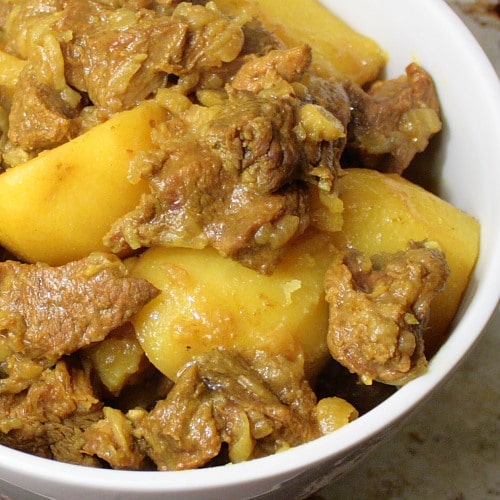
Mangsho Jhol, or lamb and onion curry

With the temperature outside struggling to reach the heady heights of -2C, the heat and warmth of a good Indian curry has never felt more appropriate.

Start with 800g to a kilo of cubed lamb or mutton, preferably off the bone, but if you can cope with the fiddliness of a few bones in your curry, you’ll be rewarded with an extra layer of flavour.

Add a teaspoon each of ground cumin, coriander and turmeric, and between a quarter and one teaspoon of chilli powder.  Crush a couple of cloves of garlic to a pulp and grate and mince a tablespoon of fresh, peeled ginger and add these to the meat as well.

Mix everything together thoroughly and set to one side for a few hours so that the spices can work their way into the meat.  The lamb will be all the better if it marinades overnight.

Heat a generous glug of vegetable oil in a large pan over a medium heat and add a tablespoon of sugar, followed straight away by four onions, peeled, halved and finely sliced.  Stir the onions constantly until they turn a deep brown colour.  Keep the flame medium high, but don’t let them burn, just keep them moving all the time and control the heat to stop them catching.

Next, add the lamb and stir so that it browns gently, about five or ten minutes

Follow this with four large potatoes, peeled and quartered.  Stir and fry for another five minutes, then add just under two teaspoons of salt and half a pint of water.

Bring to the boil, cover and reduce the heat.  Leave the curry to cook for an hour and ten minutes, stirring it very gently a couple of times during this time.

The onions will dissolve into the gravy, thickening it.  The potatoes will drink in the spices, and should keep their shape, maybe losing their edges a little.

Finish the curry with three quarters of a teaspoon of garam masalla and serve with rice.

The curry is spicy, but not overpoweringly hot, the heat tempered by the potatoes and melting onions.

It’s quite delicious.

This is one of the peerless Madhur Jaffrey’s recipes, from A Taste of India.

Barngates Brewery, Cumbria

Food & drink
Barngates Brewery, The Drunken Duck, Cumbria

The Drunken Duck has an ace up its’ sleeve.

Out the back, they’ve got their own micro-brewery.

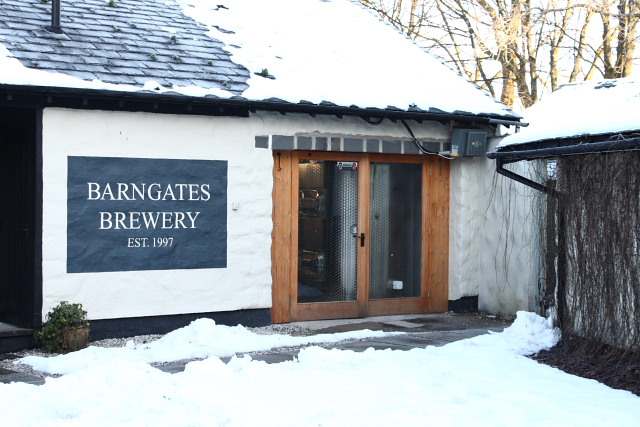
Barngates Brewery was founded in 1997, as an experiment to supply the Duck’s bar with some of it’s own beer.  In 1999, the operation was expanded to a five-barrel plant, and in 2008, with the help of some shiny new equipment, into a ten-barrel micro-brewery.

Production is now up to about thirty barrels a week, using the Inn’s own water supply, which is very soft and has a slight brownish tinge from the peat hills (“reminiscent of a malt whisky”, they say, romatically stretching the point).  We were warned that the water wasn’t to everybody’s liking, hence the presence of bottled water everywhere, but, I quite liked the earthiness of it, and this background note follows through into the beer.

Barngates produce seven regular beers, each named after one of the Inn’s former pets.  Mothbag is a light, golden ale, with the stab and tang of citrus.  It’s lively and bitter.  Tag Lag is similarly light, copper in colour, dusky and bitter.  Red Bull Terrier is a beast of a beer, a dark red brew with a hoppy smell and a malty taste.  It’s spicy and sweet, with a distinctive caramel undertone.

Barngate’s other beers include Cracker, Pride of Westmorland, Westmorland Gold and Chesters.

I’ve got a bottle of Chesters to try, but (foolishly?) vowed not to drink anything in January (there, it’s public now.  I’ve got to do it).

It’ll have to wait until February, good as it looks.

Barngates Brewery

The Drunken Duck Inn, near Ambleside, Cumbria

Eating out

We thought we might be staying longer at The Drunken Duck, by default.

The night had been cold, and the previous day’s showers had frozen over the lying snow.

We checked out and set off down the country lane to the side of the Inn, the car wheels skidding on black ice.

I was beginning to wonder if going anywhere was a good idea when an oncoming driver got a bit overenthusiastic with the brakes, his car lurching and swerving across the narrow road, shuddering to a crunching halt in a flurry of displaced snow, horizontal across the road, a couple of metres from our front bumper.

After much shoving, digging and spinning of wheels, we were on our way, but quickly turned back, passing the Inn to try a different direction, which proved even more treacherous.  We were soon back at the Inn again, only escaping its pull on the third attempt.

This all serves to prove the point that The Drunken Duck Inn is gloriously isolated, an old coaching inn sat high in the hills over Ambleside, surrounded by snow-topped fells and steep, deep valleys, a country pub in the middle of some of England’s finest countryside.

The Inn consists of a bar, made from a huge slab of slate from the surrounding hills, a restaurant, and a small hotel.

We drank coffee and ate scones in front of a wood burning stove in a quiet and calm lounge, the Inn’s cat darting around our legs, looking for a spot close to the stove.  The scones were warm from the oven, the jam runny and the cream thick enough to stand a spoon in.

For dinner in the cosy restaurant, I had a steak tartare – raw fillet beef, minced and mixed with diced cornichons and heavily seasoned, a raw egg yolk sitting proudly on top.  It was as good as any version I’ve eaten in France.  Jenny had a seafood tortellini, a massive pasta parcel of seafood with a mushroom sauce – far too big for a starter, and slightly bland.

My main course of pan-fried duck breast came with a punchy apricot stuffing, Savoy cabbage, confit potato and a redcurrant sauce. The duck was cooked pink, rare in the centre and all the better for it.  The redcurrant sauce added tartness to the rich meat.

Jenny’s roasted fillet of beef was cooked perfectly.  Medium pink in the middle, her knife fell through it with ease. The fillet was served on a gently roasted Portabello mushroom, a suitably meaty accompaniment, I think.

Desserts were a chocolate and almond torte, rich, dark and dense, with crunchy nuts hidden inside, with a generous scoop of a similarly dark and quite excellent chocolate ice-cream on top.  Too much chocolate, and too intense – the torte would have been better paired with a vanilla ice-cream.

My pear tatin was served with a scoop of gingerbread ice cream.  The pear was soft and tender and the pastry underneath had stayed crisp and crunchy.  The ice-cream was delicious.  I could easily have gone for the cheeseboard, which offered a range of eight or nine cheeses, each described in detail.

Coffee came with petit fours, always a chance for a kitchen to show off, which they duly did, with remarkable results.

Breakfast the next morning was equally good.  Herby sausages, crisp bacon, proper black pudding, warm smoked haddock with a poached egg broken over the top.

The standard of cooking at The Drunken Duck is very good indeed.  That may be an understatement, on reflection – we ate some superb food, accomplished dishes cooked with care and finesse and a good deal of technical skill.

The first thing that struck us on arriving at The Duck was the quality of the service.  As we checked in, the hotel manager discovered a box of books about local walks under the counter, dropped off by a local author.

“We should put these in the rooms.  Did they cost anything?”.

“Yes”, replied the receptionist.

“Well, we should put them in the rooms anywhere.  Here, go for a walk”, he said, passing me a book.

The lady who checked us in was friendly and efficient, explaining the peculiarities of the water supply (private, perfectly safe, but often a little peaty.  An acquired taste, she said, but actually quite nice to drink).  She asked where we’d parked, and on telling her that we’d basically abandoned the car in a snow drift, she immediately told us not to worry, there would be plenty of chefs on hand in the morning to push and dig us out.  They were getting used to it, now, she added.

This level of service and friendliness turned out to be a constant theme, from the reception staff, from the bar tender who was more than happy to describe their beers to me in detail, through to the waiting staff and right up to the manager.

Everyone we dealt with was friendly and welcoming, and that feeling seeped through the entire building.  Add that to a talented kitchen turning out some superb food, and you’re not likely to go wrong.

To top it all, they brew their own beer on site, and it’s very good indeed.

Could things get better?

Did you enjoy this post? Subscribe to more from them apples