Carpaccio of beef with rosemary

Food & drink
A carpaccio of raw fillet steak with tomato and rosemary

There isn’t much cooking involved here, just a little frantic scorching and some very thin slicing.

The seared crust of the beef is given a gutsy punch from an excess of rosemary and a good seasoning of salt and pepper.  The brief cooking time leaves the centre of the meat entirely raw.

It almost goes without saying that if you’re going to eat raw meat, make sure it’s the best you can get.  This essentially means fillet steak, with all the fat carefully trimmed away until you’re left with a long, slender chunk of pure beef.

Fillet costs a fortune, but a small amount goes a long way when prepared for a carpaccio. 400g is enough for a starter for six.

First, pull the leaves off a few big sprigs of rosemary and chop them very finely.  Season generously with salt and pepper and spread the leaves out on a chopping board.

Roll the fillet in the rosemary, pressing down firmly, so that the herb clings to the meat.  The fillet should be completely crusted.

Heat a non-stick frying pan over a high heat and add a glug of olive oil.  Gently place the fillet in the pan and cook for a minute or so on each side, keeping the heat high.  The idea is to create a crust, but leave the middle entirely raw.

Remove the fillet to a plate and allow to cool completely, before resting for an hour or two in the fridge.

To slice the beef, use a large, very sharp knife and aim for slices thinner than a pound coin.  If you can get them thinner, all the better.

Stretch each slice out gently with the back and face of the blade, and lay them on a large plate.

When you’ve sliced the whole fillet, very lightly season the meat, dress with some thinly sliced cherry tomatoes, red onion, chopped red pepper, spring onions – really anything you have to hand – and sparingly dress with a simple dressing of three tablespoons of olive oil, half a tablespoon of Dijon mustard, salt, pepper and a little lemon juice.

The seared crust is enough to encourage those who swear they’ll only ever eat well-done beef into trying just a little.

The results are stunning.  The beef is soft and velvety, with the occasional tang of mustard and a stab of lemon or pepper, the rosemary is bitter and crisp.

I served this on Christmas Day as a way around the ‘is a first course really necessary given the colossal size of that turkey?’ question.  This was a great half-way point – a big platter of carpaccio, served for people to collectively pick at.

Best of all, it kept everybody out of the kitchen for a good half an hour…

Turkey and stuffing croquettes

Food & drink
Turkey and Stuffing Croquettes

My son just asked why everything he’d eaten over the past two days had turkey in it.

It was a good question.

We told him that it’s traditional to cram an entire year’s worth of turkey consumption into a single week at the end of December, and that there was plenty more to come over the next few days.

He didn’t appear to be too impressed.

There’s a very good chance that there’s a huge amount of turkey sitting in your fridge right now.

Maybe you picked at it yesterday evening, stood in the glow of the fridge light.  Maybe you had turkey sandwiches for lunch today.  Maybe you plan to have some cold with chips tonight, perhaps the simplest and most satisfying meal of the year.

This is another option for using up some of the turkey mountain, the idea borrowed from Menu In Progress, but simplified a little.

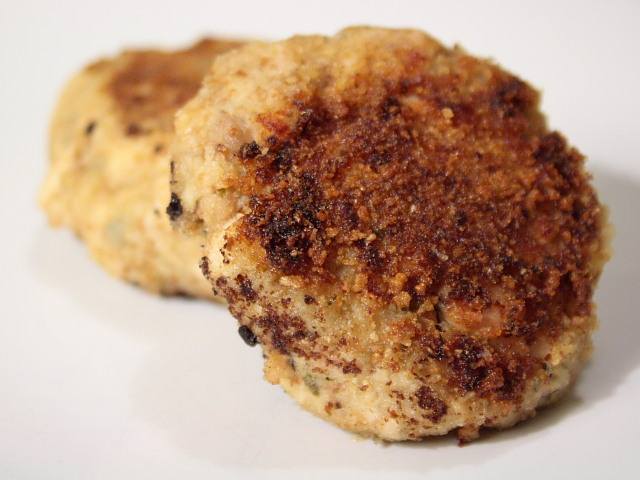
To make these simple turkey croquettes, finely dice and chop cold turkey and mix it thoroughly with approximately even quantities of leftover stuffing.  The quality of the stuffing is important, and the presence of pork and some gutsy herbs, such as sage, are vital.

Season the mixture well with salt and pepper.

Work the mixture with a spoon or by hand until it sticks together enough for you to form ping-pong sized balls.  Flatten each ball out slightly and coat in fine breadcrumbs.

Japanese panko breadcrumbs would be ideal, but a few slices of bread whizzed up in a food processor, spread out onto a baking tray and dried for half an hour or so in a low oven before receiving a second whiz in the food processor are a cheap and easy substitute.

If the breadcrumbs don’t stick easily, roll the croquette in beaten egg and try again.

Shallow fry in olive oil until golden and warmed through.  Serve with a salad.

The method on Menu In Progress includes a small amount of jellied gravy in the middle of the croquette, the gravy melting as it cooks and oozing out when cut open, like a Christmas-themed chicken Kiev.

The idea is brilliant, but today, I think I lack the motivation to actually try it.

It’s Boxing Day.  Keep things easy.

There’s another leftover turkey recipe here.

Amaretto and chocolate torte

Food & drink
Amaretto and chocolate torte Gordon Ramsay

At this time of year, I tend to over indulge a little, not too much, but enough to make me think that, yes, I really do need to go to the gym or grind out some miles along the canal bank.

This recipe was the start of the Christmas downfall for this year.

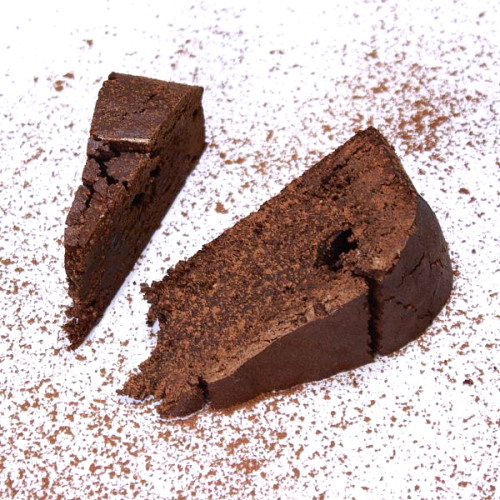
It’s rich, very, very rich indeed, a huge, decadent slab of tart, bitter chocolate gently flavoured with Italian liqueur. A small slice with a cup of coffee is enough for anybody.

This cake sat in the kitchen next to the kettle, small slithers of it disappearing whenever I passed.

Melt 350g of good quality dark chocolate in a heatproof bowl set over a pan of gently bubbling water.  Don’t stir.  Don’t prod.  Just watch the chocolate slowly disintegrate.

In a small pan, slowly heat six tablespoons of Amaretto di Saronna until it’s warmed through, before adding it to the chocolate and stirring it in.  Heating the booze helps to stop the chocolate seizing into a solid mass and ending up in the bin.

Amaretto di Saronna is an almond flavoured liqueur that, curiously doesn’t contain almonds.   The flavour comes from apricot pits and other flavourings.   It reminds me of marzipan.

Mix it with an equal measure of Southern Comfort and you’ve got a Sicilian Kiss.

Next, mix 50g of finely crushed amaretti biscuits into the melted chocolate and then stir in the beaten yolks from four large eggs.

Whisk the four egg whites in another bowl until thick and soft, then beat in 200g of caster sugar, a little at a time to make a glossy meringue.

Slowly and gently fold the meringue into the chocolate mixture, and pour the mixture into a buttered and lined cake tin, 20cm in diameter.

Bake for thirty-five to forty minutes at 180c, then turn off the oven and leave the torte inside to cool for at least an hour.  Don’t take the cake out of the tin until it’s completely cold.

Dust with cocoa powder and serve with creme fraiche or mascarpone.

This torte is from the Italian part of Gordon Ramsay’s World Kitchen.

Gordon Ramsay’s World Kitchen

Books
Gordon Ramsay’s World Kitchen

One of the things I remember best about my mum is that she used to be shocked and appalled by anything she thought was ‘rude, lewd or crude’, to use her exact and frequently repeated words.

Growing up, this boiled down into the complete and total ban on all kinds of swearing, and also, strangely, everything on ITV, which she considered to epitomise the concept of ‘rude, lewd and crude’ perfectly.  That’s another story, though.

Ordinarily, this blanket ban on all profanity would have firmly included foul-mouthed uber-chef Gordon Ramsay, but somehow it didn’t.  Mum loved Ramsay’s Kitchen Nightmares and she watched The F-Word every week, despite all the effing and jeffing.

I never asked her about this, but I think I understand.

When some people swear, it’s vile and offensive, but when other people do it, it’s not so bad.  They carry it off.  It’s part of their personality and appeal.  It’s a complete and unexplainable set of double standards.

We all loved our mum for this, and the rest of her very funny little idiosyncrasies.

I’ve been watching this series of The F-Word with huge interest, sparked by the first episode where local Italian heroes Salvo’s demolished their opponents to be named Britain’s best independent Italian restaurant.  There’s a proud banner over the door now, and no chance of a reservation until about 2015.

There’s been some superb cooking on show, and I find watching small time chefs rising to a big challenge captivating.

My brother, The Chef, managed to score a place at the eventual final, which is on at some time during Christmas week.  I can assure the production company that their non-disclosure agreement is still very much intact – he won’t tell me who’s won, despite all my attempts to bully, trick or otherwise extract it from him.

As with all things Ramsay, the latest series of The F-Word comes with a book, a great big cash-cow of a book, released conveniently in time for the Christmas rush.

No, really, I’m not cynical.

Cynicism comes easily when Ramsay is involved.  There’s been lots of muttering about him recently.  Overexposed.  Lost his edge.  A parody of himself.

It’s easy to see where these views come from.  My shelves are heaving under the weight of Gordon Ramsay’s books, and it seems sometimes that he’s never off the telly, but I’m not so sure that’s the whole story, or even the part of the story that really matters.

Take World Kitchen, the book to accompany the latest series of The F-Word.

Here’s a collection that pulls together some superb recipes from ten of the world’s best cuisines, or nine of the world’s best cuisines and America, if you want to be picky.  No cuisine is covered in real depth, but each is represented by a small clutch of first-rate and accessible recipes, things that may stretch the amateur cook, but none that would scare him or her off completely.

This is where I always end up with Gordon Ramsay.

I read his books and find myself inspired to cook his food.  Flicking through World Kitchen time and time again, I pause on a Greek walnut cake, ‘drenched in a fragrant spice syrup’, a Thai green curry of beef, Chinese pork and prawn dumplings, a casserole of pheasant, a beautifully photographed Italian amaretto and chocolate torte, a proper fish pie.

Plenty of ideas.  Plenty of inspiration.  Plenty of things I can do.

As a collection, World Kitchen works fantastically well.  There’s something here for most people.  None of it is groundbreaking or completely new, but there’s a vibrancy and enthusiasm that’s infectious and exciting, a love of food and a mastery of craft that sets this book apart from the rest of the celebrity chef pack.

Thanks to Quadrille for sending me a copy.

Jenning’s Snecklifter

Food & drink
Jenning’s Snecklifter Lakeland beer

Another classic Lakeland beer, from the recently flood-hit and therefore underwater Jenning’s Brewery in Cockermouth, Cumbria, Sneck Lifter is a deep, dark and rich beer with a coffee flavour and a malty finish.

It’s a warming winter beer, with a potent dark red colour.

Jenning’s make much of the name.  A “sneck lifter” is a man’s last sixpence, which he could use to lift the ‘sneck’, or latch on the pub door and buy himself a pint.  The last coin, used properly.

Perfect for Christmas.

Jenning’s Brewery