Opposite Coffee, Leeds, redux

Eating out
Opposite Coffee, Leeds

I’ve written before about Opposite in the Victoria Quarter in Leeds, and I don’t normally write about places a second time, but this story needs telling.

I spent yesterday morning trudging round the centre of Leeds with the rest of Yorkshire looking for elusive Christmas presents, things for those people who’ve got everything and need nothing. The tough ones.

There’s only so much time I can spend doing the retail thing, and even making a break for Crash Records didn’t seem to help, so I went to the Opposite kiosk in the Victoria Quarter for a coffee instead.

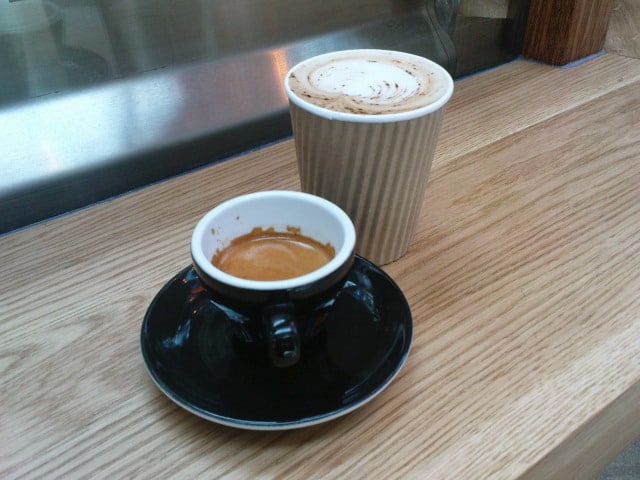
I ordered a double espresso, and the barista carefully measured out the correct dose of coffee, tamped it down well and set the machine up. He let the hopper and the cup warm through before pulling the shot.

The coffee poured down, a dark brown stream, a crema forming in the cup.

The barista looked a little unsure, and peered into the cup.

He then threw my coffee down the sink.

“What was wrong with that?”, I asked.

He explained that he thought the shot was too thin because it drew through the grounds five seconds too quickly and therefore lacked the body they’re looking for. It would have tasted weak, he told me, so it had to go. They were using a new winter blend and were still getting used to it, and things like the amount of moisture in the atmosphere and the temperature affect how the coffee draws.

Sometimes it just isn’t right, and when it just isn’t right, it goes down the sink

I was astounded. Such attention to detail. Such care. Incredible stuff. This is coffee making as an artisan craft.

I mentioned that I’d never seen anybody do that in Starbucks and got a knowing glare in return.

The espresso was superb – chocolatey and bitter, a definite winter, cold weather feel to the roast, no astringency. It tasted like the beans had been treated well and hadn’t been overworked.  They’d just given up their richness and done their job.

There really is no better coffee in Leeds.

Opposite, Leeds.

The Thai Emerald, Cheltenham

Eating out
The Thai Emerald, Cheltenham

We’d walked a long way, from the famous bridge over the River Kwai into Kanchanaburi, the nearest town.  Thailand had been hard work.

It was hot.  Very hot.

Even the women who patiently and carefully watered the grass in the Allied cemetery were wilting among the stark white tombstones, each bearing a British name and a familiar place.

Manchester.  Leeds.  Huddersfield. Sheffield.

We stopped at a small restaurant by the side of the road, little more than a shack with a few curries and some rice on the go.  There were four vats, each holding a different curry.

I pointed to the one on the left.

The waiter shook his head and laughed.  Too hot.

What about that one?

More laughter too hot.  No way a foreigner could eat that.

The next one?

Maybe, but still a note of derision.

The last one?

He grudgingly sold me the last one.  I could tell in his eyes that he thought it might actually kill me.

The curry was red, rich, hot.  Very hot, but delicious.  That’s my benchmark curry.  That’s what Thai food should taste like.

Nothing I’ve eaten in Britain has matched that curry, and I’m sure it never will, but few meals have even come close.

The Thai Emerald in Cheltenham was one meal that nearly made it.

To start with, it looks the part, all intricately carved teak, gold everywhere, elephants over the door and silk dresses.  It’s exactly what a Thai restaurant should look like.

We started with a mixed platter of Thai starters.  The spring rolls were fine, the spare ribs had been braised for a very long time and were soft and delicious, a huge skewer of king prawn, coated in breadcrumbs and deep fried was laced with coconut that gave it a sweet and unusual edge.

Next a soup course, tom yum talay, a blisteringly hot broth with a mixture of seafood – mussells, carved squid, white fish.  The soup had a fierce bite that attacked seconds after the sourness of lemon and lime had washed over the tongue.

As a main course, there was gaeng daeng gai, a traditional Thai red curry, tender chunks of blanched chicken in a red savoury broth, cut with lemongrass and lime, flavoured with Thai basil and finished with the savoury pungency of nam pla, or fish sauce.  The intense and angry heat of chilli was tempered by the soothing coolness and calmness of coconut milk.  Baby aubergines, tiny balls floated in the broth, popping open in the mouth.

The curry was sophisticated and complex, not as hot and edgy as the soup, more satisfying and comforting – a triumphant dish that left me only able to mumble something about it being ‘really, really good’ when my boss asked whether I was enjoying it or not.

There wasn’t the atmosphere of that meal in Kanchanaburi, but how could there be?  Food is often as much about context and experience as it is about taste, but this was a superb meal, prepared with skill and presented with care and attention.

The photo is from Cheltenham Daily Photo – many thanks to Marley for letting me use it.

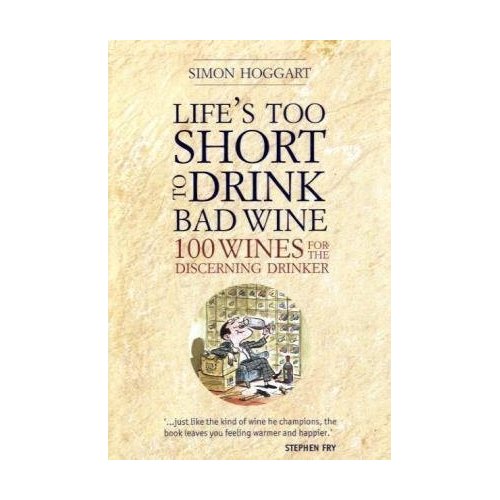
Life’s Too Short to Drink Bad Wine – Simon Hoggart

Books
Simon Hoggart’s Life’s Too Short to Drink Bad Wine

You might have noticed an almost complete absence of posts about wine from this blog.

There’s a simple reason for it.

Wine scares me to death.

The presence of a bona fide wine expert in the family doesn’t help, either, but that aside, I know very little about wine, despite drinking my fair share of it.  On the other hand, I know plenty about beer, so I don’t suppose I’m a completely lost cause.

If I had a list of things I needed to just ‘do’, ‘become more knowledgeable about wine’ would be close to the top of that list.  I want to spend my money more wisely.  I want to know what I’m getting and feel that I’ve judged the purchase well.

Simon Hoggart’s Life’s Too Short to Drink Bad Wine: 100 wines for the discerning drinker seemed to be written with people like me in mind.  Hoggart picks out a hundred of his favourite wines and writes about each in turn.  He talks about the bottle’s history, it’s heritage, it’s character, why he likes it.  He points out that “there should be a certain mystique attached to wine”, but qualifies this by adding that “this is not the same as mystery”.

This is the real purpose of Hoggart’s book.

Demystification.

There’s too much snobbishness about wine.  It’s too ‘exclusive’.  It makes people nervous.

A little knowledge can go a long way, and Hoggart provides incisive direction and advice in both general and very specific terms.  You could use this book to hunt down the actual wines described, but there is as much benefit to be gained from using it to improve your general understanding of the field as a whole, to learn enough to help you to choose more wisely the next time you’re staring down a wall full of wine at the local Oddbins.

There are secrets here, too.  On buying wine in restaurants, Hoggart advised against buying the second cheapest on the list:

“In many places it’s the one with the biggest mark-up, or the one they bought too much of and need to lose quickly.”

Thanks, Simon, I’ll remember that.  And what to actually order?

“Go for the New World.  Wines from Chile or Argentina, for example, are likely to deliver more flavour for your buck than the French equivalents.

Never be afraid to look cheap.  If it’s on the wine list in a good restaurant, it should be a good wine.  If it isn’t, it’s a poor restaurant and doesn’t deserve your custom”.

Life’s Too Short to Drink Bad Wines has one other trump card.

It’s extremely well written.

Hoggart writes with a clear and precise tone, with humour and wit.  Examples and anecdotes are well chosen and integral to the piece, illustrative of a particular point.  There is little here that’s wasted or superfluous.  Hoggart clearly knows, understands and most importantly, loves wine, an enthusiasm that runs through his writing, and much of which rubs off on the reader.

Will this turn you into a master sommelier?  No, it won’t, but it will help you to understand more about the basics of wine, and you’ll be thoroughly entertained whilst doing so.

Thanks to Quadrille for sending me this review copy.

The Boathouse Inn, Saltaire

Eating out
The Boathouse Inn, Saltaire

The Boathouse used to be one of those slightly tatty, worn-out pubs that had seen much better days.

It was just underwhelming, in direct contrast to it’s superb position on the riverbank.

The previous owners didn’t seem to have much clue about how to run the place, either.  A few years ago, on the final Saturday of the Saltaire Festival, they closed for a private function, despite the several thousand people milling around the village.  There were so many people that the beer festival was drunk dry.

The pub eventually closed and became a favourite target for any passing arsonist.  A series of fires left the building, a late add on to Titus Salt’s model village, as a burnt out hulk, its charred struts reflecting in the Aire.

The remains of the old pub were bought by the people behind the hugely successful Don’t Tell Titus…

Work started.

Walls were demolished, new ones built.

A new roof went on.

Huge glass windows appeared in doors that opened up across the whole front of the building.

The Boathouse suddenly started to look, well, quite smart, and re-opened as a pub and restaurant with a friendly and relaxed style.

We’d tried to get a table a couple of weeks ago, but found the place packed and had to trudge off to somewhere a bit second rate instead.  This time, we got there early.

The menu is a standard pub menu, with a few interesting twists, and a good range of specials.

Everything you’d expect from a straightforward pub menu is there.  If you want a plate of beer-battered fish and chips or a steak and kidney pie, you’ll be fine.  It wasn’t the most interesting or innovative menu I’ve ever eaten from, but there were good, crowd-pleasing dishes on it, which isn’t really a bad thing.

The specials are where the real interest lies.

The waitress ran through the specials for us, which included pan fried sea bass, and a dish of pig’s cheek, braised slowly in a red wine sauce.  There’s an offal dish on every day.

Jenny must have seen my eyes light up.

“You’re not having that”, she said, pulling a ‘this time I’m serious’ face.

“It’s only pig’s cheek.  They put it in sausages.  You eat it all the time”

“That’s different”

“No it isn’t”

“Yes it is”

And so on, as the waitress looked on, bemused, before telling us that they only had one left.  It did cross my mind that we’d only be ordering one anyway.

By the time we came to order, the last pig’s cheek had been snapped up by somebody else, leaving me deflated and Jenny with a mildly victorious and satisfied air about her.

I ordered the sea bass instead, Jen asked for a chicken Kiev.

The sea bass was glorious.  Two big fillets, perfectly pan fried, skin crisp, flesh still very slightly translucent, laid across a bed of new potatoes and spinach, surrounded with a rich sauce heavy with butter and cream, garnished with diced tomato.

It was excellent.

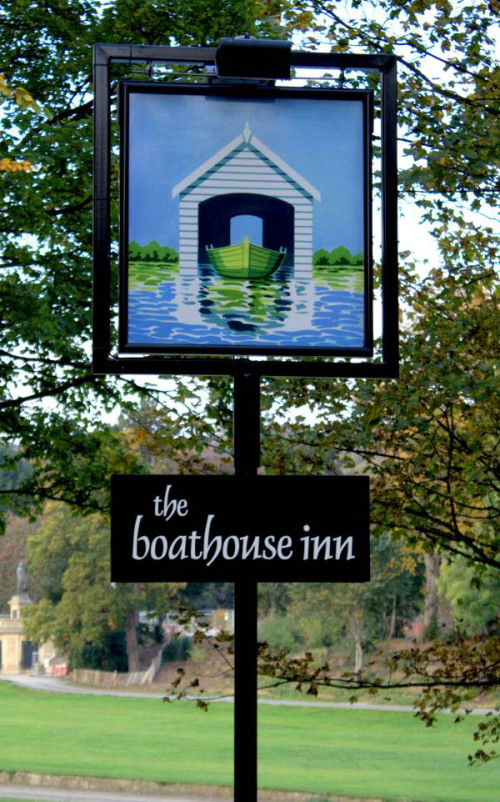
The Boathouse Inn Saltaire

Jen’s chicken Kiev missed the boat completely.

A chicken Kiev is one of those things that’s tricky to cook.  There’s a high chance that the Kiev will split open slightly during cooking, secretly leaking the contents.  The cook can’t tell if he’s been successful or not until the diner plunges a knife in to release a slick of garlic butter.

Or not, as is often the case.

Jen’s Kiev was completely empty.  No butter at all.  The chicken was a little overdone, which is probably where the problem lay, but it tasted quite good, rich with garlic and herbs.  No slick of butter, though, and therefore the point had been missed.

Jen had an Eton mess for dessert, which she thought was very good.

Despite the butterless Kiev, we had a good evening in a very smart pub. Any pub or restaurant willing to put pig’s cheek on the menu deserves a second look.  The serving staff were friendly and efficient, and the sea bass showed real promise.

All they need to do is drop the chicken Kiev, keep the kitchen open longer and introduce some sort of reservation system.

One thing to note – and this is a real clincher, at least for me – they have Saltaire Brewery’s excellent Saltaire Blonde on tap, a light and soft beer with a continental edge to it.  It’s Saltaire Brewery’s best seller, and it’s easy to see why.

Interflora’s Christmas biscuit box

Food & drink
Interflora Biscuits

What is it?
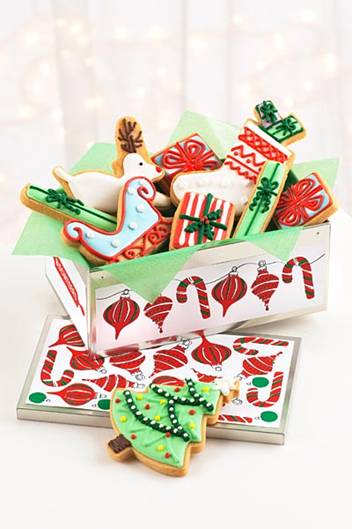
It’s a box of biscuits.  Hand-made, hand-decorated biscuits, in a nice tin box.

OK, why?
This is Interflora’s new idea.

Instead of sending a bunch of flowers, you now get the chance to send a box of biscuits instead.  It’s a good idea.  Gives people options.

That box looks very Christmassy…
Indeed it does.  This is their Christmas-themed biscuit box, packed with Christmas tree shaped biscuits, reindeer shaped biscuits…you get the idea.

What are the biscuits like?
They look superb.  Very well made and decorated.

Somebody took real pride in making these biscuits, and it shows.

The biscuits themselves are light, crumbly and tasty, but there’s a lot of icing on top, which tends to overpower the whole thing.

Does that matter?
No, it doesn’t.  I couldn’t eat more than a couple at once, but, as the saying goes, it’s the thought that counts.

How much?
Brace yourselves.

£24.99.

Twenty-four pounds and ninety-nine pence.  For a box of nine admittedly rather nice biscuits.

Postage costs another £5.99 on top of that, so this will cost you over thirty quid to get it into the hands of the object of your affections, which does seem an awful lot.

Is it worth it?
These things are relative.

The recipient doesn’t need to know the cost, so if you’re happy to pay it, it’s a good alternative to a bunch of flowers.

Interflora’s food and drink gifts are here.