Red Chilli, Leeds

Eating out
Red Chilli Chinese Restaurant Leeds

Every now and then, a restaurant comes along that just hits the nail on the head.

Red Chilli is one of them.

Down a dark flight of stairs on a busy corner in the northern part of the city, you’ll find a first-rate Chinese restaurant, busy and bustling, people queuing for tables. Waiting staff with an aloof, preoccupied air buzz back and forth carrying heaving plates of Eastern delicacies.

The menu is Sezchuan in influence, long and comprehensive.  We landed on a set menu, more through a lack of time and a need to order quickly than choice.  I was disappointed not to be able to try the pig’s trotters, but Jenny seemed relieved.

Hot and sour soup, warm and spicy with a sharp kick and a mellow sourness started things off, followed quickly by a varied platter of Chinese starters – spring rolls, prawn toast, seaweed, sweet and sour pork spare ribs.  The ribs were small and delicious.  Too predictable and pedestrian, but done very well.

A quarter of crispy duck was quickly dealt with, the duck shredded at the table and rolled up in pancakes with hoisin sauce and cucumber.  It’s a Chinese restaurant staple, but none the worse for that.

For the main course, we had deep-fried chicken breast in a spicy sauce – thin and tender strips of chicken, battered and fried with a hot and sharp sauce over them.  Beef and prawns in a Cantonese style were served in a basket of noodles.  Steamed pak choi was clean and refreshing.  An egg fried rice dish, full of vegetables and seafood provided far too much carbohydrate.

The food at Red Chilli is just excellent.  It’s a magnificent example of a Chinese restaurant, and, so I’m told, as close to traditional, authentic Szechuan cuisine as you’re likely to find in the North.  The welcome omission of any form of MSG certainly helps.

The service was a little erratic.  The people dealing with incoming customers were not that attentive, to say the least.  On arriving, I walked up to the ‘wait here to be seated’ sign and waited.

And waited.

Waiters, bar staff, the people on the counter all walked past me as if I were invisible.  We ended up on ‘the list’ only after Jenny’s assertive intervention.

That said, our waitress was excellent, sending us away with the substantial leftovers from the rice dish for lunch on Sunday.

Red Chilli is a great example of a proper Chinese restaurant.  The food is great, the prices are reasonable, there’s no chemical additives and the dining room looks the part.

Next time, I’ll explore the more esoteric parts of the menu more.

Next time…

Red Chilli on Urbanspoon

Confit of rabbit

Food & drink
Rabbit confit

Rabbits are plentiful, sustainable, cheap and healthy*.

Cooked properly, they’re delicious.

Cooked badly, they’re about as appetising as an old boot.

I’ve found that farmed rabbits can be successfully roasted with lemon, rosemary and garlic, but try the same treatment with a lean, muscular wild rabbit and the dish generally ends up in the bin.

On the other hand, cook a wild rabbit in a slow cooker with tomato, wine, garlic and onions, and you’ll end up with tender meat and a pasta sauce to end all pasta sauces.

Farmed rabbits tend to be plumper and softer, the flesh not as exercised as their wild brethren.  Try to find out which sort you’re buying and keep that in mind when you’re deciding what to do with it.

This method is simplicity itself, and guarantees the most tender rabbit possible.

Lay the leg and shoulder joints from two rabbits out in a single layer in a casserole dish and salt with a couple of tablespoons of sea salt.  Cover and refrigerate for a few hours, up to six should be OK.

When you’re ready to cook, quickly rinse the joints of excess salt and pat dry with a clean tea towel.  Rinse out the casserole dish too, and return the rabbit to it.

Add a handful of black peppercorns, a bay leaf and a good sliver of lemon peel to the dish and cover the rabbit with melted duck or goose fat.  It’s always difficult to work out how much fat will be necessary – this time, I used three 300g jars.

The meat should ideally be covered by the fat, but if it isn’t, don’t worry.  Just turn the meat over a few times during the cooking process.

Cover the dish with foil and put it in a low oven, 150c, for at least an hour and a half.  If you’re using wild rabbits, they’ll take much longer, maybe another half an hour or forty minutes extra.  The meat is ready when it’s meltingly tender when prodded with a knife.

Using a pair of tongs, lift the cooked joints into a large, clean Kilner jar, tucking them in tightly.  Pour the fat into the jar, making sure that it completely covers the meat.

The fat will set, encasing and preserving the meat.  When you want to eat some, just dig out a joint and flash it in the oven for ten minutes to crisp up.

The rabbit will keep like this for weeks.  It’s tender to the point of collapse, salty and bursting with flavour.

This recipe is from Tom Norrington-Davis and Trish Hilferty’s superb Game: A Cookbook.

* Rabbit meat is healthy.  Duck or goose fat, with salt, is not.  Beware.  This is not everyday food.

Pheasant ballotine, stuffed with pork, prunes and pistachios

Food & drink
Pheasant Ballotine

“My father was standing on the edge of the clearing with the moonlight streaming down all over him and a great bunch of pheasants in each hand.  His face was bright, his eyes big and bright and wonderful, and he was staring around him like a child who has just discovered that the whole world is made of chocolate”

Danny, The Champion of the World – Roald Dahl

We read Danny, The Champion of the World at bedtime, a chapter at a time, Ethan tucked up, listening intently, lost in the story in a way that only a seven year old could be.

I’d read Danny before, at school when I was about Ethan’s age.  As I read Roald Dahl’s words out loud, I realised that I knew the whole story.

I remembered it all.

The caravan, the workshop, slitting the raisins open with a razor blade and stitching them back up again, Victor Hazzell, the policeman, the thud of the pheasants as they rained down out of the trees.

It’s a wonderful book, a truly glorious work of fiction, and worth reading even if you don’t have a seven year old to read it to.

It seemed appropriate to cook some pheasant in honour of Danny, his father and Roald Dahl himself.  This recipe is quite unusual, but it’s very successful.  It’s suitable for birds from the tail end of the season, the ones that are a little tougher, having spent Christmas and the New Year in the woods.  These bids need a longer and slower treatment.  They need stews, casseroles, poaching.

Start by boning out two pheasants.  This may seem daunting, but it’s quite easy.  Start on the back and carefully and gently cut the breast meat away from the rib cage.  This is all much easier if you remove the wishbone first.  Carry on carving the meat away, working your way carefully around the leg bones, popping the joints from their sockets as you go.  The aim is to keep the skin completely intact.

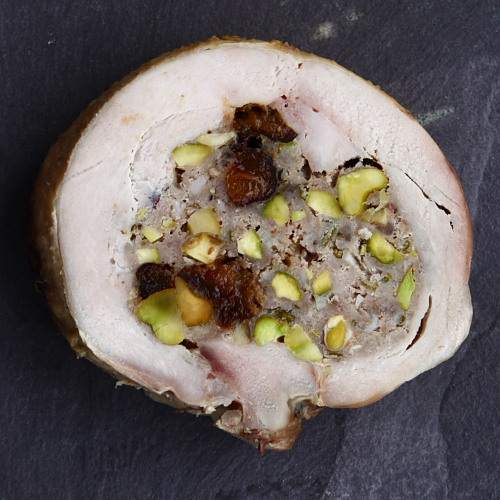
Next, make some stuffing from 300g of coarsely minced belly pork, three chopped rashers of streaky bacon, 100g of pitted and quartered prunes and 75g of roughly chopped pistachio nuts.  Add three generous tablespoons of brandy to the mix, along with two cloves of garlic, finely chopped together with the leaves of a sprig or rosemary.  Season well with salt and pepper and mix thoroughly.

Lay the boned out pheasants on a board and season the fleshy side.  Divide the stuffing between the two birds, spreading it evenly down the centre third of each bird.

Gently pull each side of the pheasant over the stuffing and roll it up into a big sausage, tying firmly with butcher’s string.  Secure the ends with a couple of toothpicks to stop the stuffing spilling out.

To cook, poach in a litre and a half of stock.  Any poultry based stock will be fine, but the best result will come from a stock made from the pheasant’s carcasses.

Poach for forty minutes, covered, the stock barely bubbling.

One pheasant will be enough to feed two people.  If there are only two of you, it’s still worth cooking two pheasants – this ballotine is sensational cold and thickly sliced, served with a chutney and some good cheese.

The best place to eat this would obviously be with Danny and his dad, sat on the steps of their caravan.

This recipe is from Tom Norrington-Davies and Trish Hilferty’s excellent Game: A Cookery Book.

Game: A Cookbook

Books
Game: A Cookbook post image

There are a lot of myths about game.

It’s hard to get hold of.  It tastes strong, sometimes bitter.  You’ll crack your teeth on lead shot. You can ruin a dish by cooking it for a few seconds too long.

As with all myths, these and most of the rest are completely untrue.

Game has a lot to offer the cook, and even more to offer the diner.  It has a sense of homely exoticism about it, of something special, traditional, rooted.

Heritage in a pot.

Trish Hilferty and Ton Norrington-Davies’ book Game: A Cookbook is a detailed look at game in all its guises, and provides a useful starting point for the aspiring game cook, or more likely, the cook who’s happened to chance upon a couple of rabbits or a brace of pheasants and hasn’t the slightest clue what to do with them.

I fall firmly into this category. My experiences with game have been mixed.  Some recipes have worked, others have failed in a spectacular fashion.  I realise now that my  techniques have been off the mark.  A  pheasant is  not simply a small chicken.  Lesson learnt.

Game: A Cookbook divides its subject into three broad sections, dealing with animals with two legs, four legs and no legs at all, essentially birds, mammals and fish.  It’s a clever approach and marks the crossover in cooking methods amongst members of each group, playing on the synergies and the possibility of substitution.

There is plenty to inspire.  Basic roasting techniques are covered well, with proper attention to the intricacies of dealing with different species.  There’s some exotic approaches, rabbit in Thai yellow curry, an Indonesian-style roast wild duck along with plenty of traditional standards such as a venison Wellington or a startlingly old-fashioned rook pie.  There’s the odd bit of charcuterie as well.  Wild duck ham, a cured and dried duck breast will be in production this afternoon.

A couple of pages of stuffing recipes towards the back will come into their own next Christmas.  Sage and breadcrumb stuffing should be an early shoo-in when I turn to planning Christmas dinner in December.

Hilferty and Norrington-Davies’ book is a huge triumph.

It succeeds on many levels, not merely as a stand-out cook book with accessible and engaging recipes.  Above that, it’s an inspirational book, shining a light on an under used and under appreciated collection of ingredients that really deserve more attention.

Hugely successful, and worthy of a place on any cook’s bookshelf.

All photos are copyright Jason Lowe, and in my opinion, are superb. Photography often makes or breaks a cookbook, and Lowe’s pictures are a complete joy.

Thanks to Absolute Press for sending me a review copy.

Alex James’ Blue Monday cheese

Food & drink
Alex James’ Blue Monday cheese

Alex James is an unlikely cheese maker.

As Blur’s bass player, James claims to have drunk a million pounds worth of champagne in three years, whilst contributing to some of the most innovative and  enduring records of the last twenty years, both of which I suppose are significant achievements, just in very different ways.

All things come to an end, and the inevitable in-fighting and parallel success of Damon Albarn’s side projects left Blur on the shelf, leaving James free to try something new.

Making cheese in the country was clearly the obvious choice.

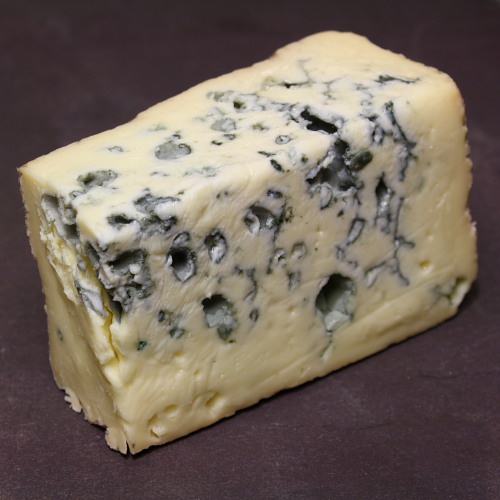
Blue Monday is a creamy Shropshire blue, sharp with a very faint sourness, named in honour of New Order’s eighties classic.  It’s an excellent name, and a superb cheese.

I’d love to see the newly reformed Blur back in the studio, but at the expense of James’ second career as a cheese maker?  That’s a tough call.

Blue Monday is available from Coxon’s Kitchen, a great little deli and cook shop on Gordon Terrace in Saltaire.  Their website is here and their Facebook group is here, both of which, along with the shop itself, are well worth a visit.

I couldn’t possibly write about both Blur and New Order without including some of their work, so here’s New Order’s Blue Monday:

As for Blur, this could have been Tender, Beetlebum, Girls and Boys, To the End, No Distance Left to Run, Charmless Man, There’s No Other Way, Song 2 or any one of a dozen more.

Here’s Out of Time:

Just be thankful I resisted the temptation to drag up that bloody awful Fat Les abomination.

Note: somebody on this forum has just pointed out the obvious irony of Alex James’ cheese being sold at Coxon’s Kitchen.  I’d love it if Coxon’s Kitchen was owned by Graham Coxon, but it’s actually run by a nice bloke called Matt, who, as far as I know is no relation to Blur’s guitarist…