
People often talk about bread making as a bug of some sort that people catch.
Well, I’ve definitely caught it, and in an effort to move up a rung on the artisan bread making ladder, I made a batch of bagels.
This isn’t a quick recipe.
You need to time things carefully so that you’ve got your bagels ready at the appropriate time, which is obviously Sunday morning. Preparation is key, and good things come to those who wait…if I could cram another cliché into this sentence, I would, but you get the idea.
More bagels this way…
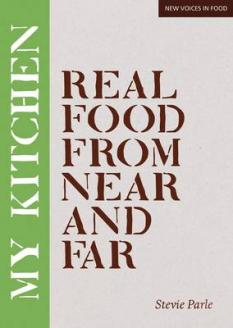
“The truly delicious things are not always those that cost a fortune, but those that have been passed from generation to generation; you can taste their integrity.”
Stevie Parle’s book My Kitchen: Real Food from Near and Far isn’t constrained by geography. This isn’t a collection of recipes with a defined focus on a particular cuisine. It’s a collection that jumps and flits, moving quickly between continents and styles, tastes and techniques. Parle explains that the things that interest him are “simple recipes that have evolved out of love, excess, or poverty…the dishes of stalls and temples, homes and cafes from around the world”. It’s this search for authenticity that binds this book together, that gives it its voice and its direction
My Kitchen: Real Food from Near and Far is an eclectic mix of recipes from all over the world, some from areas whose food hasn’t ‘broken through’ into the British kitchen just yet. Homemade pork pies – the real deal, pig trotter jelly and all – butt up against a Cambodian dish of pepper crabs and Vietnamese banh mi – sandwiches of slow cooked pork shoulder with pickles. There’s a Bakewell tart next to a bouillabaisse, grilled leeks in a Romanesco sauce near a sour mango curry.
More this way…
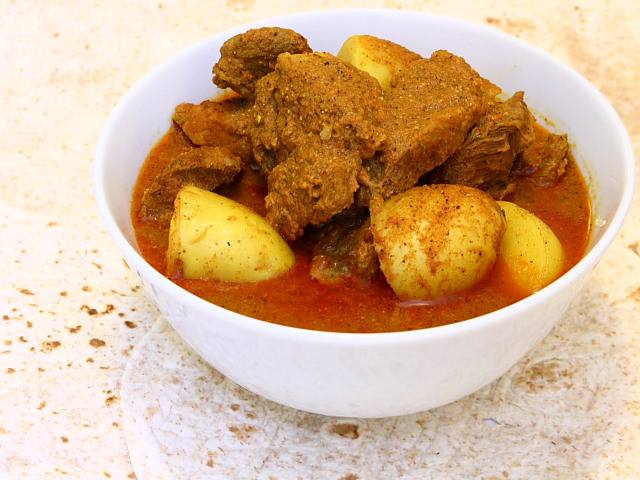
This is it.
This is the most abused, mistreated and misrepresented curry in the whole of the world.
There isn’t another Asian dish that comes close to this one in terms of how people view it.
Its reputation is right down there in the gutter. A vindaloo is nothing more than a macho challenge after sixteen pints of lager and a fight.
The British curry house version of a vindaloo does the recipe a great dis-service. Yes, it’s a hot dish, it’s fiery, but it’s really quite an unusual curry, with an interesting provenance.
The vindaloo has its roots in the south of India, in the seafaring states of Kerala and particularly Goa, the areas formally colonised by the Portuguese. The Portuguese brought with them carne de vinha d’alhos, a traditional feast dish of meat cooked in red wine with garlic. The vindaloo represents the collision of Portugal’s culinary heritage with that of India. Carne de vinha d’alhos gained some spices, a lot of chilli, and somewhere along the way, the wine gave way to vinegar, and the vindaloo emerged.
A vindaloo can be made with any type of meat, but it should really be pork, which again nods to its origins in Goa’s Portuguese Christian communities.
It’s a fascinating cultural history, and an excellent example of how food transcends cultures and grows because of that.
[continue reading…]
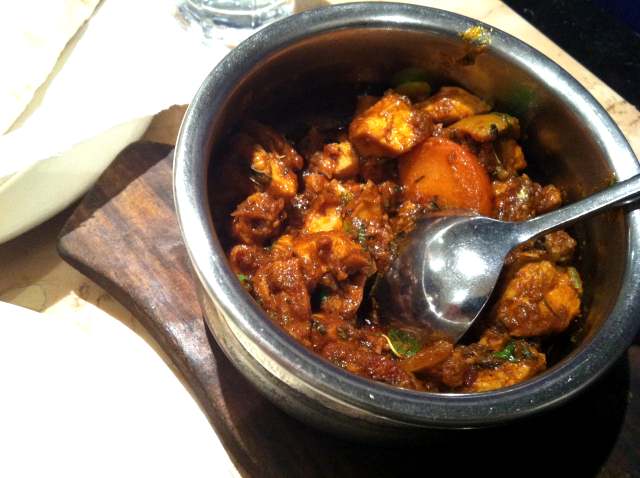
I said the other week that the standard of Asian restaurants in Bradford was on the slide. It’s not that there aren’t good places out there, it’s just that some of them don’t seem to be trying very hard anymore.
I forgot that whenever I say something like that, the opposite is normally proved right, and so we found ourselves in The International.
The International is another one of Bradford’s simple, straightforward, no-frills cafe style Asian restaurants, and it’s a great example of the type.
The service is quick and friendly, the prices are great and the food is tasty – hot, fresh, spicy and full of flavour.
[continue reading…]

I write a lot about restaurants, and I’ve written before about my reservations in doing so, but as this blog has grown (beyond my wildest expectations, it must be said), I’ve been approached more and more often by restaurants who want me to write about and review their places.
The basic approach, normally through a PR agency, is along the lines of ‘come and have a free meal, then maybe you could write a post about it?’.
For several reasons, I never feel entirely comfortable with this, which leads me to the central and tricky question…
Can you review a restaurant if you didn’t pay for your meal?
As with many ethical questions, the answer is far from straightforward. There are many different points of view and motivations.
I can understand entirely why restaurants would want people like me to write about their restaurants – it creates a buzz, and some presence on the Internet. A lot of that buzz will be quite localised, as most bloggers tend to concentrate on a certain area, so it seems natural for restaurants on their patch to want to be featured.
A comped meal is a small price to pay for some decent, targeted exposure.
More this way…
