Prison food never tasted so good – Underground, with We, the Animals

Eating out
A review of the Underground pop-up restaurant at Leeds Town Hall, by We, the Animals.

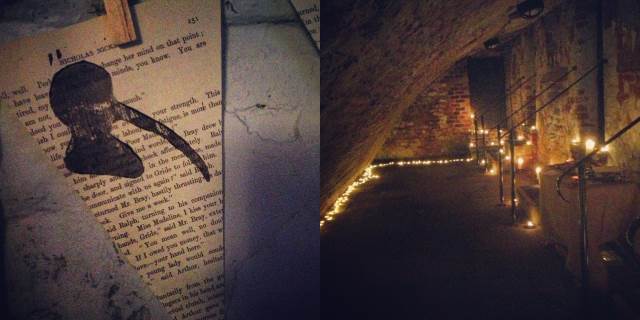
The bright, white paint on the walls was cleaner, and the lighting perhaps a little softer, than it might have been in the past, but this was definitely a prison cell, a prison cell transformed for one weekend only into a pop-up restaurant by the food collective We, the Animals.

It was a strange evening right from the start, from the time we spent sat on the steps outside the Henry Moore Institute, watching Friday night in a northern city grind into action under the last part of the day’s blazing sun, that strange crossover time where the workers either leave, or join the party people as they start to emerge for a long evening and late night.

We tried to spot others who knew the secret that the Town Hall held that night, but there didn’t seem to be any. It crossed my mind that we might be alone, or that this was going to be a complete disaster, as these pop-up things can at times be. The signs were encouraging, though – I’d spotted an advance party from Laynes Espresso lugging gear towards the Town Hall, so I knew that at least the coffee was in good hands.

The first surprise was that there really is a jail under the Town Hall. When I’d booked tickets to this We, the Animals event (I nearly typed ‘gig’, then … would a pop-up restaurant ever be a ‘gig’?), I’d suspected that the ‘jail’ part would be a conceit of some sort, maybe a cleared-out storage space in a dark Victorian basement that was pretending to be something it wasn’t, but there was no doubt that this place had seen service as a correctional facility.

The iron rings on the walls spoke volumes about the way Victorian inmates were probably treated, and the cell door had a certain heft to it that screamed of tolerating no nonsense. More ….
How hard is it to knock a coconut over? … or chicken, coriander and coconut curry

Food & drink
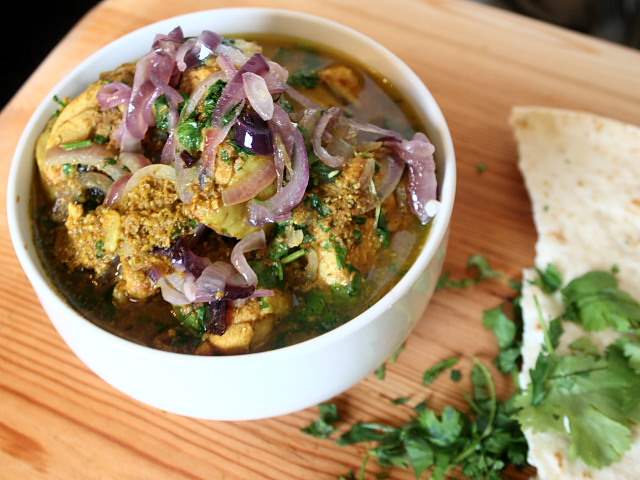
A Keralen chicken, coriander and coconut curry, from Christine Manfield’s Tasting India.

It was the school fair on Saturday, and among the bouncy castles, secondhand toy stalls and pop-up cafes selling the most excellent pakora wraps with fiendish chilli sauce, there was a coconut shy.

The rules of a coconut shy are very simple – throw a ball at a coconut perched on top of a stake, knock it off, keep the coconut.

Now, remember that this is a primary school, and the kids are quite little, so they found it quite hard to actually knock the coconuts over.

The coconut shy did decent business, but there wasn’t a noticeable number of kids wandering around proudly clutching a coconut, puzzling over how the hell they were going to smash it open.

As the idyllic, hot afternoon wore on, it became obvious that the enormous pile of coconuts used to supply the shy wasn’t diminishing, which presents a problem for the stall holder … so the rules were gradually, shall we say, relaxed.

Lara stepped up to the line at about the time that the rules had descended into something basically resembling ‘pay 50p, throw a ball in the general direction of a coconut and you’re a winner! Whoop! We’ve got an expensive AV system to pay for!’

So, mission:accomplished. We had a coconut, that was swiftly turned into a curry.

This is a Keralan dish, from the south of India, a little removed from the normal Rajasthani, Punjabi or Kasmiri dishes I tend to favour, and it shows a different side to India’s endlessly varied cuisine. It’s heavy on coriander seed and chilli, which makes it wildly powerful and aromatic, but tempered with the cooling milkiness of coconut. I promise to cook more from the southern parts of the sub-continent.

More…

5 reasons to bake your own bread

Food politics
5 reasons to bake your own bread
  1. You know what’s in it – bread is only flour, water, yeast and salt. That’s it. That’s all you need to make a world-class loaf. Have a look at the ingredients listed on the side of a commercial loaf and ask yourself whether all of those things are really necessary, or are they there just to help the producer turn out a flimsy loaf as quickly as possible. Another important point – bake your own bread, and you know how much salt is in it, and it’ll be a more sensible amount than in most commercial loaves.
  2. It’s good value – my normal loaf costs about sixty pence to make, and I drive the cost down further by baking four at a time and freezing three. You’ll be lucky to find any palatable bread available in a supermarket for less than a quid.
  3. It’s creative – bread baking is addictive. It starts with a simple white batch loaf for most people, but the opportunities for experimentation and creativity are almost endless. Sourdoughs, flatbreads, enriched loaves, croissants, heavy, dark Eastern European rye breads, baguettes, different methods of shaping, scoring, baking …
  4. It’s good for the soul – baking bread is a calming, relaxing activity. It requires patience and time. A good dough needs space to grow and develop its character. Embracing the idea that good things come to those who wait isn’t such a bad thing, really.
  5. It tastes far, far better – this is the real reason … your bread, the bread that you made yourself, the bread that you put your heart and soul into, is always going to taste better than a mass-produced loaf. I’d be prepared to go so far as to call this an indisputable fact. You’ll have to give it a go yourself to prove me wrong, and that won’t happen, because that loaf you make will do exactly the opposite – it’ll prove me right.

Here’s an easy, step-by-step recipe for a decent white loaf, and the techniques and ratios can be bent to accommodate any type of flour or loaf. You might want to be more adventurous, so have a go at a loaf made with apples, or maybe an authentic baguette, or you could just jump in at the deep end and go for the mother of all loaves, the sourdough.

Whichever you try, savour the process as much as you enjoy the bread.

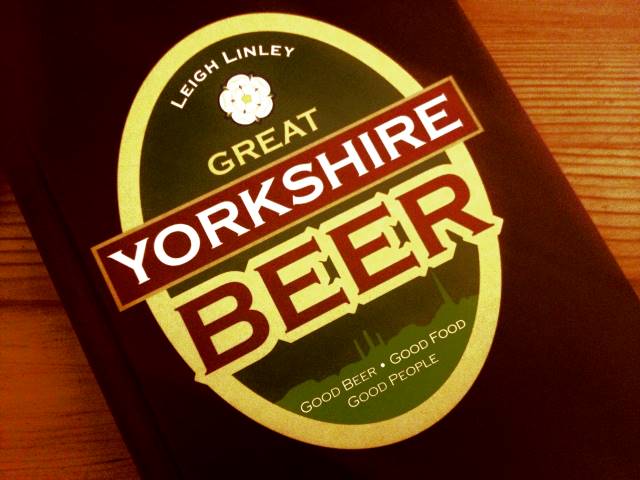
Great Yorkshire Beer, by Leigh Linley

Books
Great Yorkshire Beer, by Leigh Linley

The past few years have seen an explosion in craft brewing in Yorkshire, with small breweries popping up everywhere, producing a wide range of styles of beer, beer of real character and quality.

This revolution in brewing has left Yorkshire with 123 breweries, but without its biggest, most iconic brewery, after Carlsberg pulled the plug on the Tetley brewery in Leeds city centre.  This is an important point, and it felt like a tipping point in regional brewing when the closure happened in 2011, one of those earth-shaking, confidence-knocking events that cause people to ask questions, to doubt themselves.

There was no need for such worry.

Those 123 breweries were alive and well in the background, and the loss of Carlsberg’s shadow seems to have freed them to be more active, more adventurous, more … Yorkshire.

Today, Yorkshire beer stands out as world-leading craft beer, with innovative and exciting breweries dotted all over the counties. There are simply loads of them, and locally produced beer is available everywhere from the pub to the aisles of the local mega-corp supermarket.

Leigh Linley’s first book, Great Yorkshire Beer, tackles the state of the Yorkshire beer industry head-on, taking a joyous tour around thirteen Yorkshire breweries, telling their stories, their tales of adversity and success, of hard work and quiet triumph, interspersed with recipes for the type of food you’d want to pair with a decent beer – calamari, fried onion tart, cheese and mustard scones, that sort of thing.
More…

Memories, dreams, reflections, roasting trays

Food politics
Memories, dreams, reflections, roasting trays

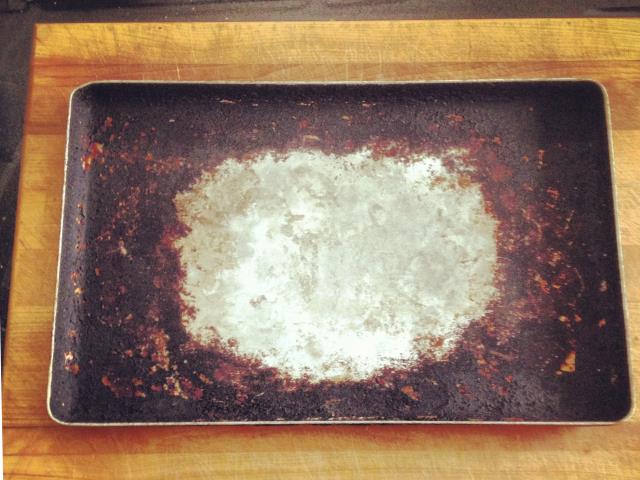
This tray must be at least 50 years old.

It was my Grandma’s, & she used to line it with grease proof paper and bake shortbread biscuits on it, always with a mixture of butter and Stork margarine.

We’d watch 60’s Batman on Saturday mornings as she baked and cooked, the smells filling the small house, Grandad sat in his high-backed chair, even then tipping over the edge into very old age and dementia.

I can see this tray now, sitting in its place on top of the cooker in that tiny kitchen. It was a big, old cooker, the type with a ferocious gas flame and a grill on high that needed lighting with a match, risking flashback every time you lit it.

When Grandma died, this tray came my way, and I’ve used it for roasting things, mainly chicken, hence the chicken-shaped clean bit in the middle. It’s nothing much to speak of – just a simple roasting tin of the type that live in kitchens the land over, but this one is mine, and it’s one of those things that are of no value, but priceless, all at the same time.

I dare not clean it too much, scrub away the charred build up of meals past and memory, because doing so would wash away the things I remember most about those Saturdays spent watching my Grandma cook.

All this from a simple baking tray.