A very good chocolate brownie

Food & drink
An exceedingly good cake – chocolate brownies with pecans

There’s nothing quite like a good chocolate brownie.

It’s not quite a cake, not quite a biscuit, but more of an indulgence than either.  A good chocolate brownie recipe is one of those things every cook should have up his or her sleeve.

This recipe is excellent, a straightforward brownie recipe with an extra flourish that lifts it above the mundane.

Start by melting 225g of dark chocolate in a bowl set over a simmering pan of water.  The quality of the chocolate is paramount, and it should have at least 70% cocoa content.

Leave the chocolate to melt, gently.  Don’t stir it, just keep the flame low and let it melt.

Sift 110g of plain flour, 70g of cocoa powder, and half a teaspoon each of salt and baking powder together into a large bowl and set aside.

Very good chocolate brownie

In another bowl, beat together 225g of softened butter and 200g of caster sugar until light and coffee coloured, before slowly mixing in two beaten eggs and another two extra yolks.

Fold in the flour and cocoa and mix in 120g of halved pecan nuts.

Tip the mixture out into a square cake tin, 20cm by 20cm, and bake for sixteen minutes at 160c.

The normal test for cake doneness does not apply here.  The point of  a chocolate brownie is that it should be soft and gooey in the middle, slightly undercooked.  Test the brownies with the point of a knife – if the blade comes out with some bits stuck to it, but the cake mix isn’t raw, it’s done.

Very good chocolate brownie

Leave to cool completely before turning out and cutting into twelve massive or twenty-four sensible pieces.

The ‘leaving to cool’ part can be difficult.  After she’d finished with the spoon, Lara checked the brownies every five minutes for an hour before pulling up a chair and declaring that she’d ‘just watch them for a bit’.

She still had to wait until after teatime to try one, though…

This recipe is from Canteen: Great British Food, which is just a complete joy of a cookbook.

Very good chocolate brownie

Canteen: Great British Food

Books
Canteen: Great British Food

There’s no point at all in beating about the bush here.  I’ll show my cards right from the start.

Canteen: Great British Food book struck me immediately as one of those cookbooks that’s going to see some heavy use in my kitchen.  It will soon be battered and splattered, spilled over and greasy, such is the fate of all my favourite cookbooks.

Canteen: Great British Food is about proper British food, the dishes that form our culinary history.  The cover resembles a wartime ration book, a clue to the contents.  The title is blunt and no-nonsense.

You know you’re going to get classic, well-prepared, nostalgic recipes.

Steak and kidney pie, made the proper way with Guinness.  Scotch eggs. Fish cakes with mushy peas.  Chargrilled pork chops, with sage.  Roast duck legs. Chocolate brownies.

Canteen: Great British Food

There’s a quiet and unfussy simplicity to Great British Food, and it’s a clever philosophy.  These are recipes with echoes, recipes loaded with meaning that reverberate through people’s lives.  Beef stew with dumplings takes me straight back to lunchtime on a Saturday in my Grandma’s kitchen, watching her make dumpling mix in the bowl from a Kenwood Chef.  Even the photo looks like my Grandma’s dish.  Here is evocative food.

This approach isn’t without risk.  A cookbook full of dishes widely regarded as ‘British classics’ is likely to raise hackles in some quarters.  With a ‘classic’ dish, everybody has a different idea about how that dish should be cooked, and a different idea about why their version, and nobody else’s, is the best.  Meddling with the classics is fraught with danger, but Great British Food addresses this risk as it should be addressed – head on – with an unapologetic and unpretentious canter through some of Britain’s best food.  These are above everything else, good, solid recipes.

That’s not to say that Canteen: Great British Food isn’t stylish, because it is.  There are flourishes of real class here, not least of all in the witty and unusual photography – intelligent and original styling, with the odd small woodland creature for good measure.  Trust me, it works.
There’s a difference between ‘nostalgic’ and ‘old-fashioned’ and it’s a line that Great British Food treads carefully.  There’s a modern edge to many of the recipes, a respectful updating of methods and ingredients.  It keeps the food relevant, but maintains it’s lineage.

The real achievement here is in taking food that we all love and breathing new life and vitality into it.

Canteen: Great British Fooddeserves a place in every British kitchen.

Canteen: Great British Food is published by Ebury Press at £16.99, hardback.

More great coffee in Leeds – La Bottega Milanese

Eating out
More great coffee in Leeds – La Bottega Milanese

There are plenty of places to get a cup of coffee in Leeds, but the problem is, most of them are very bad indeed.

If you want the best part of a pint of steamed milk with a shot of badly roasted espresso in it, there’s a Starbucks or one of it’s clones on nearly every corner.

But there’s better coffee out there.  Much better.  You just need to search out the exceptions.

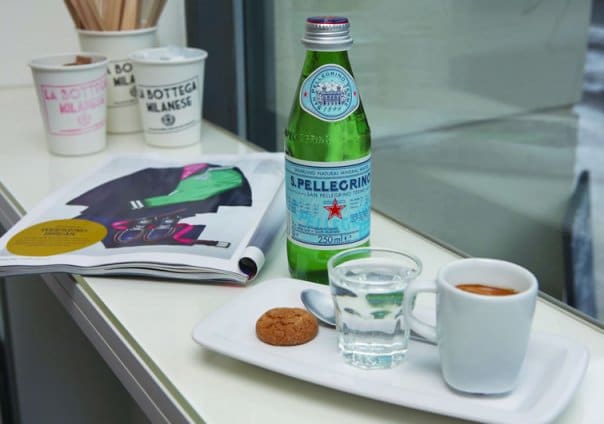
La Bottega Milanese is very definitely one of these exceptions.  An authentic Milanese coffee bar tucked into a small part of The Calls, La Bottega is run by an enthusiastic Italian, Alex, with a real and very, very obvious love of his craft.

I’d heard a lot about La Bottega since they opened last December.  They’ve caused quite a stir and developed a strong following, so it was inevitable that I’d pay them a visit.  I didn’t expect to be recognised straight away, though!  Alex had read this blog, and said that he’d been expecting us.

I had a straight shot of espresso, rich and rounded with a thick crema.  Excellent coffee.  Very, very good indeed.  I followed this with a cappuccino, a first rate example of the form, the rich espresso mellowed by the steamed milk under a frothy cap of foam.

Alex told me that he has his beans roasted to his own specification, a typically Italian roast.  An Italian roast is normally lighter in colour and less oily than a more common French roast or – God forbid – the nearly cremated beans that Starbucks use.

This is an important point.  The taste of the finished drink is entirely dependent on the quality of the beans and the way that they’re roasted.

Paying attention to the roast pays dividends in the cup.

Whilst we were there, several other customers came and went.  Each was warmly greeted and had a chat, each waited for their drink to be made from scratch.  Nobody’s order was rushed.  Everybody got a great cup of coffee.  Alex had time for everybody who walked through the door.  Just as it should be.

La Bottega Milanese is a wonderful little place, a great example of the type of small, independent, artisan business that Leeds should be proud to have.

La Bottega Milanese

La Bottega Milanese on Urbanspoon

Wholemeal apple and orange cake

Food & drink
Nigel Slater’s Wholemeal Apple and Orange Cake

Every now and then, I have to make a cake.

The urge often strikes at this time of year, with the indulgence of Christmas a fading memory and no sign of the rotten weather passing soon.  This cake provides a hint of what’s to come, using last autumn’s fruit.

Line the bottom of a 20cm cake tin with greaseproof paper and heat the oven to 160c.

Weigh 220g of soft butter and 210g of light muscavado sugar and beat them together until smooth and pale.  An electric whisk will make short work of this.

Slowly add four beaten eggs to the butter and sugar, stirring all the time.  If the mixture splits, add a spoonful of flour and keep mixing.

Fold in 250g of sifted wholemeal flour, along with a heaped teaspoon of baking powder and half a teaspoon of cinnamon.

Chop 200g of peeled and cored apples into chunks no more than a centimetre square.  Add 100g of sultanas to the apple and mix in 125g of marmalade and the grated zest of an orange.

Scrape the fruit into the batter and gently fold in.

Tip the mixture into the cake tin and sprinkle the top with demerara sugar.

Bake for an hour and fifteen minutes, and leave to cool completely before serving.

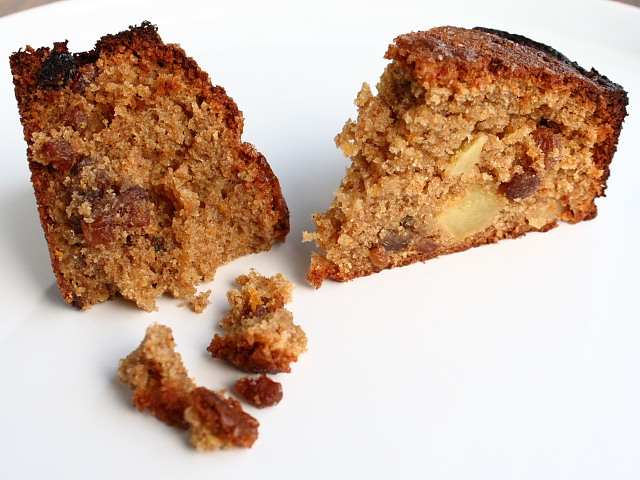
The cake is thick with the taste of orange and the sweet smack of apple.  There’s a wholesomeness about the texture, from the flour, which might even convince you that it’s healthy.

This recipe is from Nigel Slater’s Observer column on the 14th February this year.
Brewdog’s Paradox Imperial stout – seriously strong beer

Food & drink
Brewdog’s Paradox Imperial Stout

Brewdog is a small Scottish brewery with a formidable reputation for creating a marketing stir.

They’ve been chasing controversy since 2007 with a combination of marketing stunts, engaging with social media and some ridiculously strong beer, peaking with last year’s Tactical Nuclear Penguin at a collosal 32% ABV.  That’s a beer that will literally knock your socks off, as shown here.

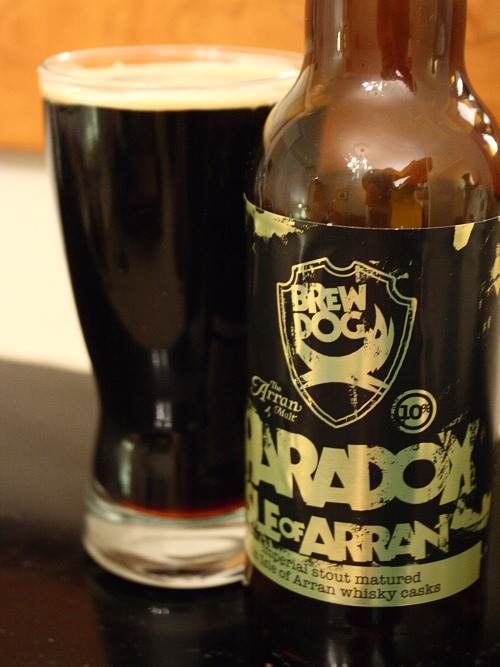
I opted for something a little more sedate, less showy-off.  Paradox, is nowhere near as strong as Tactical Nuclear Penguin, at a mere 10%, but it’s still a seriously strong brew, worthy of careful handling and a certain amount of respect.

Paradox is an Imperial stout, heavy and dark with a whiff of chocolate and the distinct kick of liquorice characteristic of this type of beer.

But there’s more.

Much more.

Paradox is matured in old whisky barrels.  The result is an extra dimension, a dry and scorching alchoholic layer to the beer, which provides a sharp initial twang and a long, lingering vanilla aftertaste.

The barrel’s journey adds to the beer’s complexity – there’s the scent of bourbon, betraying the whisky barrel’s past life housing American bourbon, which gives way to the the spicy sweetness of Isle of Arran whisky at the end .

Other whisky barrels are used, giving the same beer a slightly different edge.

Paradox is an incredible beer.  It’s absolutely stunning.  Rich, warming, complicated and delicious, it’s a triumph.

One bottle is more than enough, though.

This bottle came from Beer Ritz in Headingley, Leeds, easily the best off-license I know.  They have an Internet operation here, and the shop’s manager, Zac, also has a superb blog.  Zac and his colleagues are seriously enthusiastic about beer, and it shows.