Slow-roasted, char-grilled, very big beef ribs

Food & drink
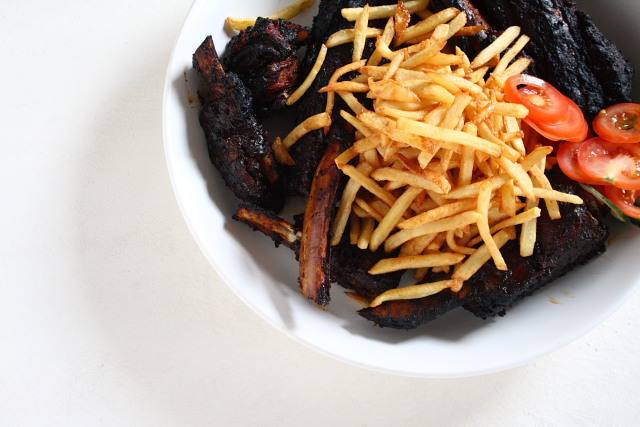
Slow-roast, char-grilled barbecue beef short ribs

I was at the market the other day.

I’d gone for some sausages, but left with a handful of pig’s ears (more on which later), some pork belly, a ham hock, a kilo of mutton and a huge tray of beef ribs, about 5kg of mammoth ribs, each about a foot long and loaded with chunks of well-marbled beef. It was a good, but unexpectedly expensive trip.

I had no idea whatsoever what I was going to do with those ribs, but they were one of those things that simply had to be bought. Mere details could be ironed out later.

This sort of thing is very much in fashion these days … Leeds is scattered with places serving excellent beef and pork ribs, and barbecue-style food of all kinds is big business. The standard approach to beef ribs seems to be long, slow cooking, finished over a flame grill. There is normally a concoction of barbecue sauces and glazes in the mix, too.

Faced with my mountain of raw beef, my feelings ran along the ‘if it isn’t broken …’ lines.

This isn’t fast food. The whole process took nearly two days to complete, the result of a seriously long period of marinading butted up against a long time in a low oven, but the results were worth the wait.

Beef ribs are huge. There’s no getting away from that – cows are big beasts, and their ribs match their stature. All the preparation needs to be done by the butcher – there’s no chance whatsoever that you’re going to be able to cut through a beef rib in a domestic kitchen. Your butcher has a saw for that. I made the mistake of not asking for the ribs to be cut down, so I was left with a side of ribs that were easy enough to separate out, but only into a clutch of huge, almost foot-long pieces, which really should have been cut in half length ways for easier handling. I tried to cleaver the bones in two, but it felt like the cow was just laughing at me – the cleaver just bounced off the bone.

It didn’t really matter, and the comically large pieces of  beef made an almost Flintstones-esque impact at the table.

More…

The Blog North Awards, 2013

Food politics
Blimey. I won the Blog North Award for best Food & Drink Blog, 2013.

It isn’t often that I win things, especially for writing about what I made for dinner, but that’s exactly what’s happened. I find myself in the unusual, strange and slightly intoxicating position of having this blog named Best Food and Drink Blog by the good people at the Blog North Awards.

The Blog North Awards ‘celebrate the best of Northern England’s independent publishing, and aim to bring some of the great new writing being published online to a wider audience’. They’re presided over by a scarily qualified panel of writers, journalists and people very much in the know about these things, who decide on a shortlist, and then eventual winners with the help of an online vote.

As I write that, I can’t quite believe I’ve actually won. When I found out that this blog had been shortlisted, I nearly fell off my chair, and on seeing that the shortlist also included one of the very blogs that had inspired me to start writing (Leigh Linley’s superb The Good Stuff), I felt quite chuffed to be even in the running.

That was A Good Day’s Work, as they say, and I was more than happy with being shortlisted.

Imagine that! Shortlisted as one of the best blogs in the North by some seriously talented judging-type people! It’s simply astonishing.

To win the category is something else entirely, and a day on, I’ve still not quite accepted that it’s true. It feels humbling, exciting, thrilling and every other superlative I could possibly throw at it, but most of all, it’s a wonderful feeling to have my work recognised and validated so publicly.

More

Tasso ham – first steps in smoked meat

Food & drink
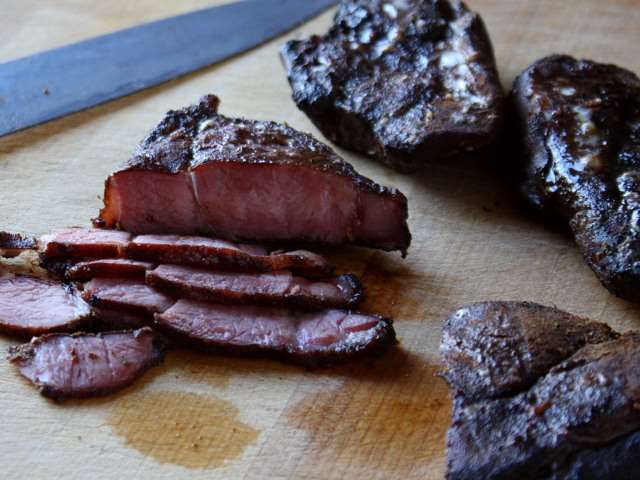
Smoked Cajun Tasso ham

Preserving meat … sounds like something that could go badly, botulism-riddled wrong, doesn’t it?

Charcuterie is a a slightly daunting area, and it isn’t an undertaking to be taken lightly. I’m nowhere near ready to cure and air-dry a whole leg of pork, or equipped to maintain the specific temperature or level of humidity suitable for curing salami or pepperoni.

There are no dangerously modified fridges around here.

Not yet, anyway.

There’s a halfway house, though … there are plenty of charcuterie recipes that you can make that aren’t quite as temperamental as some of the more artisan air-dried produce. The air drying process starts with something raw, and ends, after curing and drying, with something that you can eat without having to cook it any further, something that’s properly preserved and that will keep for months.

The halfway house involves curing the meat, then cooking it in some way. Bacon is a perfect example of this method – cured meat that has a definite shelf life, and obviously needs cooking, until it’s crisp, please.

Here’s an easy introduction to this particular brand of pseudo charcuterie called tasso ham. It’s a Cajun delicacy, pork shoulder steaks cured quickly, smothered in big seasonings, then smoked until cooked, all achievable with kit that lives in the average shed.

More…

Panmarino, or Italian rosemary bread

Food & drink
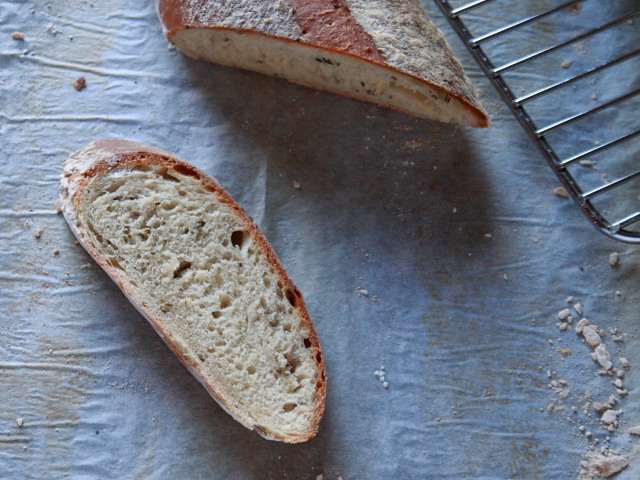
Panmarino, or Italian rosemary bread

I made a pain au levain the other week, a French sourdough shaped like a torpedo, and full of glorious air holes, encased in a brittle crust.

It was a textbook example of why ‘slow is best’ when it comes to baking bread. The levain, or starter, was set up the night before, giving it a cool, cold early autumn evening to develop and build its structure and flavour.

The difference that using a levain and letting it mature overnight was incredible – the finished bread tasted of time, tasted of every last bubble of carbon dioxide that the slowly growing yeast culture gave off in the dark, small hours as we all slept. That was real bread, bread with attitude.

This is another type of continental bread that uses broadly the same technique to develop taste and a little backbone.

This time, a normal yeast is used in the starter in place of a sourdough culture. The initial dough is called a biga, because this is an Italian bread … the French equivalent, a starter made with baker’s yeast, is a poolish. The biga lives in the fridge for anywhere between eight and seventeen hours before forming the basis for the bread dough, which itself goes through a long, slow fermentation to allow the dough to develop flavour and complexity.

Don’t let anybody tell you that good bread can be made quickly – it simply can’t. Time is a vital ingredient in the very best of loaves.

This bread, a panmarino, is bolstered with olive oil and flavoured with fresh rosemary. Rosemary goes with olive oil as well as fish goes with chips – they form a wonderful partnership, the olive oil providing richness and depth, the rosemary a piquancy that mellows and settles as the dough bakes.

So, start with the bigaMore…

The spoils of war, or blackberry and apple jelly

Food & drink
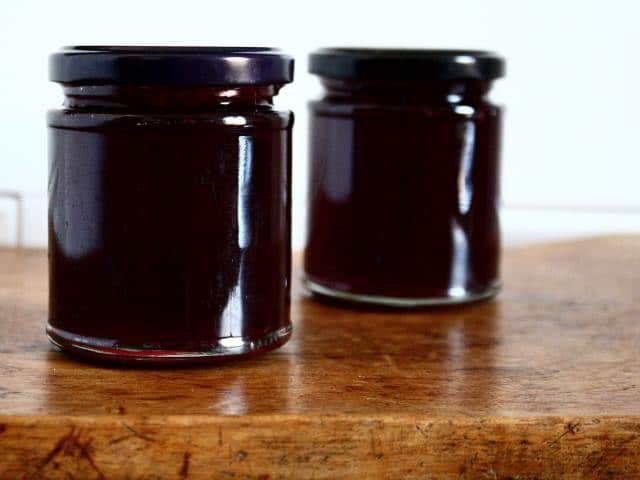
Blackberry and apple preserve, jam or jelly.

I’ve become obsessed with keeping the exact location of the best blackberry bush in the whole of Shipley a secret, even going to the trouble of deleting the geotags from a photo I took of the view when I was stood right next to it. I swore the kids to absolute secrecy.

They won’t talk.

There are blackberries everywhere around here – the ones lining the canal are OK, better towards Bingley than Leeds, but they’re in plain sight and quickly stripped bare by passers-by. Those berries are smaller, and tend to suffer a light coat of dust from the towpath. There are other spots around and about, but the secret one me and the kids use is the best one, on a shallow slope overlooking the valley and it’s mills and houses, with bushes just hidden down a sudden steep part, away from the path, steep enough to dissuade people who don’t really want to get some fruit. The bushes are left largely undisturbed, and the fruit is big, sweet … perfect little bombs of flavour, just hidden away.

We gathered about four kilos this year, in the peace and the quiet, the grass damp from a shower, the jet black fruit glistening in the humid air. There were the usual scratches, nettle stings, and assorted injuries that go along with any foraging expedition, especially one centred around a frankly quite aggressive plant. Nothing this year that needed hospital treatment, though. Picking blackberries is a type of combat – it’s you against the plant, and the plant has the upper hand, mainly because it has spikes, and likes to use them.

More…