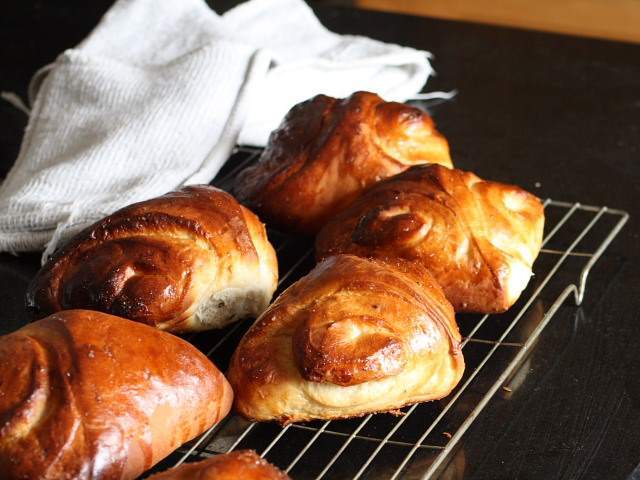
Finnish pulla buns

Food & drink
Finnish Pulla buns

Here’s something a little different – a sweetened dough from the Nordic countries, particularly Finland. It’s the Northern European version of brioche, a bread dough packed with butter and sugar, stuffed with a variety of fruits, creams and spices, as the baker sees fit.

Pulla buns are best made as enormous, fist-sized wedges, each looking just that bit too big for a single person to eat. There needs to be some heft to them, enough to provoke a faint gasp from the recipient. Don’t be shy of shaping these buns on the large size.

As with most breads and doughs, pulla dough is best made the night before and allowed to rise and ferment overnight in the fridge. The benefits of a long, slow fermentation are incredible, and it’s the investment of this extended period of time to allow the dough to develop a character and complexity of its own that divides good bread made properly from commercial loaves and doughs made badly. And by ‘badly’, I mean ‘quickly’.

There’s nothing unusual about pulla dough. It has everything you’d expect to see in an enriched dough, with one extra ingredient – ground cardamom. Cardamom is widely used as a spice in baking across the Nordics, and it’s often found in traditional Christmas pastries. It has that distinctive taste of winter to it, a fiery pang that sits somewhere vaguely over there with nutmeg, mace and cinnamon. In this recipe, the seeds are crushed rather than completely ground, so that there’s a degree of bite left to them.
More…

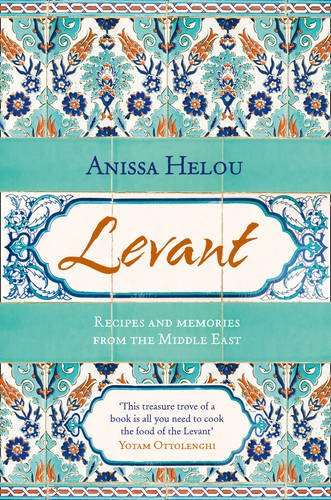
Levant, by Anissa Helou

Books
Levant, by Anissa Helou

The Levant is the part of the world where continents and empires collide, the crossroads where east meets west with a passing wave at Africa.

It centres around the Eastern Mediterranean, encompassing countries like the Lebanon, Syria, Jordan and Turkey, the crucible of the Mediterranean and an area still very much at the forefront of world news.

The food of the Levant is rich and diverse, holding the northern parts of Iran as its spiritual home, because the rulers of the surrounding lands in centuries past highly favoured Persian cooks, who took their food far and wide in the region. Dishes may be similar across the Levant, but there are differences in preparation, and a dish made in the Lebanon could be markedly different from the same dish made in Syria, or elsewhere. This difference in regional style adds to the depth of the region’s cuisine … Lebanese food centres on tartness and fresh flavours, meat and fruit are common combinations in Syria and Iran, Jordanian and Palestinian food leans towards subdued, comforting flavours, where big, complex flavours are king, yet all have a common theme of ingredients, flavour and technique.

Anissa Helou’s book, Levant: Recipes and Memories from the Middle East, is as comprehensive and encyclopedic a view of the cuisine  of the Eastern  Mediterranean, or Middle East, as you’re likely to find, a fascinating, engrossing and beautiful account of a life illustrated by food. Helou grew up between Syria and Lebanon, and documents the food of her home countries delicately and in detail, widening her attention to the surrounding lands, describing in detail the food and customs of these most vibrant and vital of culinary lands.
More…

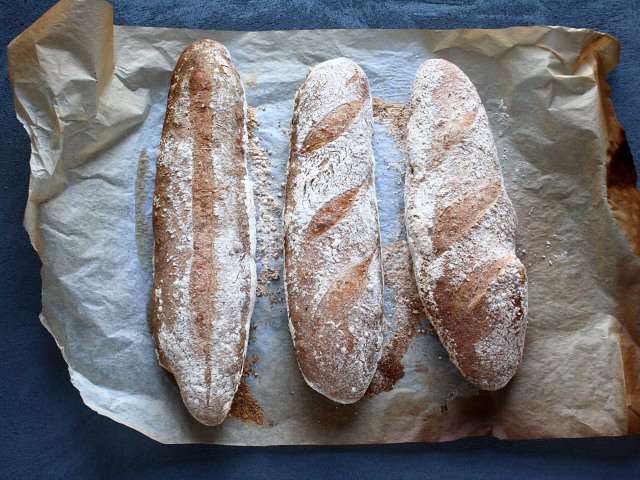
Pain au Levain, or a basic French-style sourdough

Food & drink
French sourdough

I used to think that sourdough had to be, well, sour … that it had to have a deep, acidic taste that almost made you wince. The more sourness, the better, and my trick was to let the dough rise for extraordinarily long periods of time, to let the acidity that’s a by-product of fermentation and bacterial growth develop and take centre-stage in the taste of the loaf.

Those loaves were good, a particular type of sourdough that nods more towards the very acidic and heavy breads of Eastern Europe, but there’s another way to look at sourdough.

The French style of sourdough is much lighter and sweeter, and the French taste leans much more towards avoiding sourness altogether while still hitting that mark of crisp crust and huge holes characteristic of the very best slow fermented breads. The balance is one between the way the yeast is introduced, via a relatively young levain that’s had a night to develop its character, and the combination of white and whole wheat flour.

The resulting bread is quintessentially French, in both taste and appearance.

Making a pain au levain is dependent on a sourdough starter being available. Despite what you might have heard, starting a starter and keeping it going is very easy indeed, and once it’s  up and running, it needs only the barest attention, perhaps five minutes a week or less. Having a sourdough starter resting in a Kilner jar in the fridge is a wonderful thing. There are instructions on how to get started with sourdough here, and remember that it’ll need a week or so to establish properly.

More…

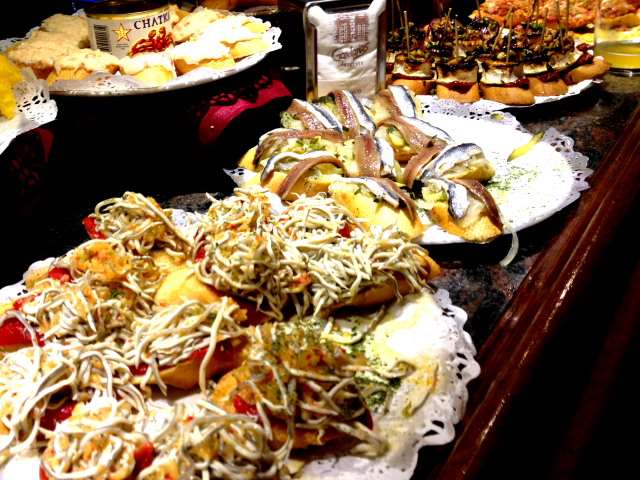
How to order pintxos in San Sebastián, Spain

Food politics
Food in San Sebastián, Spain

We spent some time in Donostia San Sebastián in northern Spain, a beautiful city renowned for its food, and held by many to be the culinary capital of the region, if not the whole of Spain.

Why, then, did we spend a couple of perplexing evenings eating some of the worst food I’ve ever ordered anywhere in the world?

Torrid pasta, limp pizza, thrown-together fish dishes, over-priced, under-value, ill thought through cooking. Terrible, terrible food, only made palatable by wine.

There was a problem, and we quickly worked out that the problem was us. Eating out in San Sebastián is a very, very different affair to doing the same thing in Britain.

Let me explain.

The Spanish conundrum

I need to eat in the evening, at a normal time, maybe 8pm or something like that. When we eat out at home, that’s the sort of time we book a table for. Seems to work OK.

The Spanish customarily eat their evening meal much, much later, at maybe 10pm or beyond. That makes finding a good restaurant that doesn’t fall into the ‘shit tourist racket’ category extremely difficult until a point where I’d be literally on my knees with hunger.

So, how do the good people of San Sebastián do it?

They have a little filler, something to ‘put them on’, as my dear Mum used to say.

Pintxos.

They eat pintxos (spelt with an ‘x’ in Basque, as pinchos in Spanish), the northern Spanish version of tapas … glorious, bite-sized snacks, usually made up of something elaborate on a slice of bread and available strewn casually across every bar in the city, huge waves of bewildering food designed almost entirely to either get you through to a proper meal, or to soak up the alcohol.

It’s a very, very good system, and gives the casual diner the opportunity to taste some extraordinary cooking at knock-down prices. Making pintxos is a competitive sport among most bar and restaurant owners in San Sebastián, and when that sort of thing happens, everybody wins.

Our hastily revised strategy involved embracing the idea of the pintxo wholeheartedly, feeding the kids properly at our apartment before we went out, to avoid the ‘I don’t like that, and I’m going to starve myself in protest’ situation, and hitting the bars for four or five plates of pintxo each … at between 1.8 Euros and 3 Euros a plate, about 10 or 12 Euros worth a head constituted a decent meal. Everybody loved it, and the kids discovered calamari. More…

A very short film, in which a disaster occurs

Food politics