Chicken & Other Birds, by Paul Gayler

Books
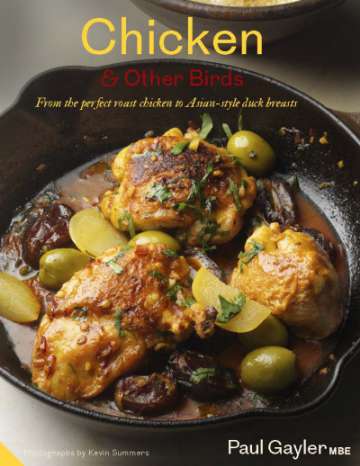
Chicken & Other Birds, by Paul Gayler

A chicken.

In our house, most usually found chucked into a roasting tin with a quick baptism of olive oil, salt and pepper, then unceremoniously slammed into a hot oven for an hour and a half.

There’s nothing wrong with that, and as a zero effort default dinner, there’s little to compare to a well-roasted chicken, but – and this is a very big ‘but’ – it feels lazy. It feels adequate, but unadventurous. It feels safe.

A chicken is a versatile thing. It leans towards a great many types of cooking, and it’s present in the food of most nations, so there are options out there should you choose to go looking for them.

This book, Chicken and Other Birds by Paul Gayler, collects together about a hundred of these options. A very useful collection it is too, focussing largely on chicken, but taking in the bird’s near relations, such as duck, guinea fowl, pigeon, quail, turkey and goose.

More…

Mumtaz, Bradford

Eating out
Mumtaz, Bradford post image

I got home from work last night and dumped my bag in the normal place, the place where it shouldn’t be.

My son was loitering about, and there was something on his mind, something that he didn’t seem to want to ask.

“Dad? Hmmm. Well, I was thinking that seeing as its just us, maybe we could go for a curry, maybe? What do you think? Please say yes.”

Yes, that was a good idea, and I’d already decided that we were going to do exactly that anyway, so he didn’t really need to bother being so bashful.

The big question was ‘where’?

Now, in Bradford, that’s quite a difficult question, because amongst its many charms, Bradford is blessed with a multitude of first-rate Asian restaurants. There’s so much choice that it’s almost embarrassing.

We kicked around a few names, and somebody whose opinion I trust very much indeed suggested on twitter that Mumtaz was the only answer, so Mumtaz it was.

I haven’t been to Mumtaz, that blinged-out temple to curry up Great Horton Road, for many years, but it’s still exactly the same as I remember it – shiny, showy, marbled, slick and a little bit ostentatious. There’s an enormous photo of the Queen eating there during a visit to Bradford. Really, it’s enormous … billboard sized. Everything is huge.

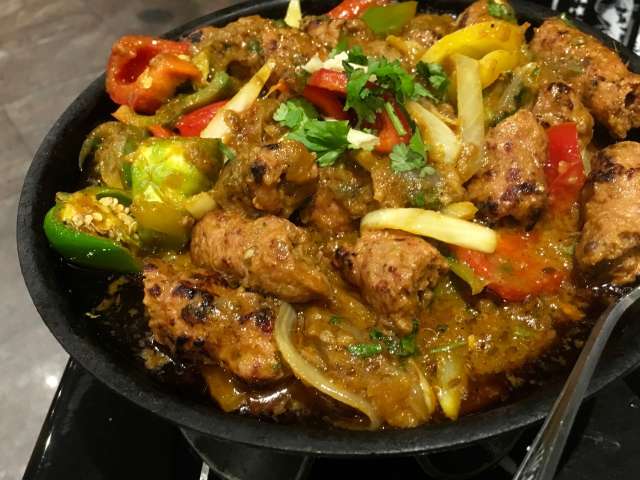
The waiter looked a little taken aback when Ethan ordered a dish of lamb kebab pieces cooked in a rich sauce, pointing out that that particular dish only came in a medium or hot version, not mild. Ethan gave him his best ‘yeah, OK, whatever’ look and ordered it anyway on the basis that a) he was born in Bradford and therefore this sort of stuff is in his genes, and b) he knows that he can take the heat with the best of them, and this is no idle boast because he actually can.

We had a couple of starters first, a plate of onion bhajis laced with coriander and spices, and the single best lamb samosa I’ve ever had, a small parcel of shatteringly crisp, almost filo like pastry wrapped around an explosive package of minced lamb.

Ethan’s kebab dish arrived, the waiter looking mildly frightened as he put it down. I had a lamb karahi, a sizzling pot of meat still bubbling on a charcoal burner as it arrived at the table. Ethan started to eat, picking up a huge chunk of meat with a piece of naan bread, a slight hush descending over the restaurant.

Something was going on.

More …

A Year in Cheese: a Seasonal Cheese Cookbook, by Alex and Léo Guarneri

Books
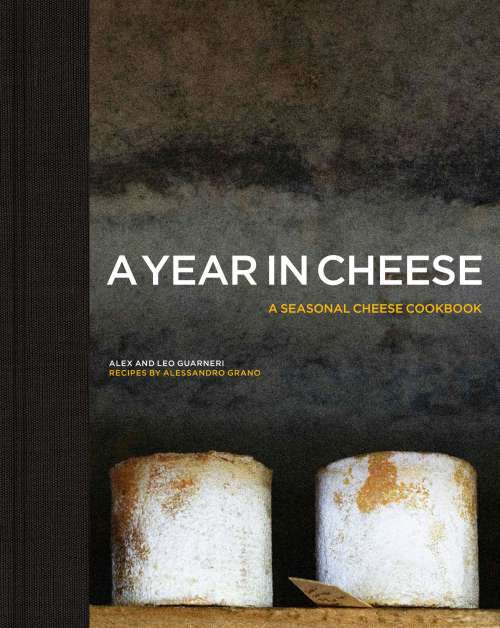
A Year in Cheese: a Seasonal Cheese Cookbook, by Alex and Léo Guarneri

Cheese isn’t the first thing you’d normally think of as a seasonal product, but it very much is.

It stands to reason, really – a cheese is the result of the specific treatment of a set of ingredients, and those ingredients will, of course, change given the way that the world changes around them. The diet of the animal that has an enormous effect on the flavour of its milk , so the resulting cheeses can and do change in flavour as the seasons progress and as they mature.

This book, Alex and Léo Guarneri’s A Year in Cheese: A Seasonal Cheese Cookbook is about understanding that principle and embracing it in the kitchen.

And what a book it is – a knowledgeable, informed, joyous tour de force of a cookbook that meanders through the light, young goat’s cheeses of spring, through the soft cheeses of summer – ricotta, mozzarella – before turning to autumn’s harder cheeses, the ones that have matured with the year … cheddar, Gruyère and the like, before ending with the big, bold beasts, the cheeses that explode with flavour and depth, such as Stilton, the product of the summer, the spoils of the winter.

Each season has its own mood, has its own character and cheeses to go with it, and each chapter in this wonderful book has its own feel, the food developing as the seasons change, from light salads of mozzarella and pickled baby artichokes, right through to hearty stews of beef cheeks, marinated in wine overnight, cooked slowly for an eternity and served with a mash considerably enhanced by the presence of Gruyère.

More…

Stirato, or an Italian take on the baguette

Food & drink
Stirato, or an Italian take on the baguette

Italian baking, and Italian bread in general, tends to be a lot more relaxed than French baking.

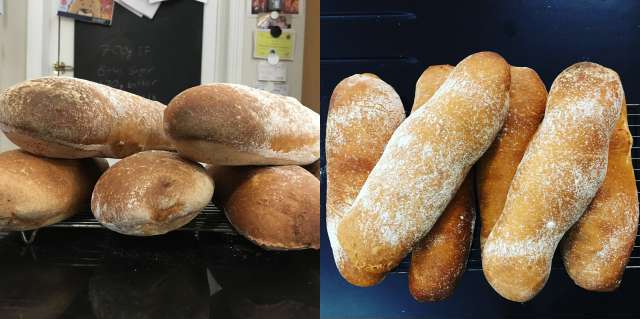
Where a Parisian baguette must have a specific number of slashes, and be baked to a certain hue and uniformity, an Italian ciabatta ‘passes’ if it looks vaguely like a slipper. Italian bread is a lot more rustic, and this stirato, the Italian version of the French baguette is a classic example of that.

It lacks the slickness, the sleekness, of its French cousin, but gains an artisan quality and an individuality that’s quite endearing.

I like this.

It means that my ham-fisted attempts to shape baguettes are fine here, where they would be laughed out of any French bakery. A slightly wonky Italian baguette is not a problem, nor should it be.

A stirato is made with a pre-ferment called a biga. This is really a method of boosting the taste and flavour of the finished loaf by developing a starter dough well in advance that will eventually be used as the base of the final dough.

The starter dough, or biga, is a stiff, fairly dry dough made with a small amount of yeast and allowed to ferment slowly in the fridge for anything up to sixteen hours. The result is a very ripe dough that shares some characteristics with a sourdough starter – both give that spine and backbone to a bread that’s generally missing from a loaf made the from a dough that’s simply mixed, risen, knocked back, shaped and proved over the space of a few hours.

A biga is typical of Italian baking, a poolish of French. The main difference is that a poolish has more water and is therefore looser. It does the same job, but doesn’t ‘hold’ as well in its ripe state. More…

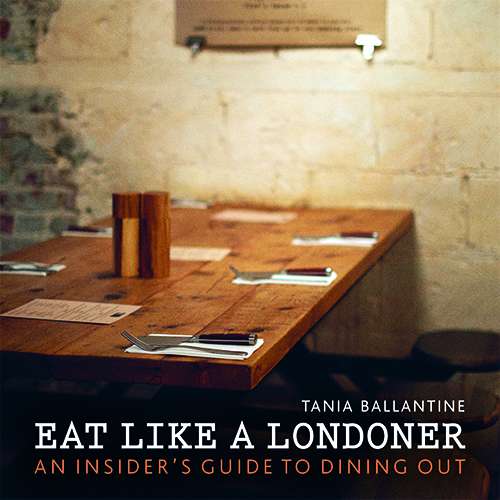
Eat Like a Londoner: An Insider’s Guide to Dining Out, by Tania Ballantine

Books, Eating out
Eat Like a Londoner: An Insider’s Guide to Dining Out, by Tania Ballantine

Ever stumbled into a new city, a place brimming with possibilities and with a reputation to match, and found yourself completely overwhelmed, fumbling around for somewhere to eat, realising that all the good places are closed/rammed/somewhere else, and being forced to settle for some lazy tourist trap with barely a local in sight?

This happens to me all the time, because I’m terrible at planning things out.

Since the dawn of twitter, things have got a little bit better, and I’ve used the Hive Mind to pin down quite a few good places in new cities at the very last second, having failed to do the whole boring planning thing beforehand, but that’s an unreliable method, if sometimes devastatingly effective.

I need to get better at that whole boring planning thing.

Books like this help, and this particular one hits right at one of my biggest blind spots: London.

Now, I know that London is a big place, and I know that restaurants come and go with an alarming regularity, that there’s always some new fashion or other just around the corner, but you’ve got to start somewhere, and a little bit of knowledge goes a long way. Tania Ballantine’s Eat Like a Londoner: An Insider’s Guide to Dining Out is a very good place to start.

This generous pocket-sized book is a run-down of about a hundred restaurants dotted around the capital of various shapes, sizes and styles. Restaurants are arranged in terms of categories, with chapters covering cult classics. late nights, ‘small & buzzy’, and so on. There are other lists that further segment places by geographical area, places that are more forgiving for the last-minute diner, and vegetarian-friendly destinations.

Well written, well presented, with lovely pictures of some frankly stunning food and dining rooms, this is a book written by somebody who obviously knows what she’s talking about, and I’d be happy to take her lead.

I must plan better next time I’m in that London.