The Beer & Food Companion, by Stephen Beaumont

Books
The Beer & Food Companion, by Stephen Beaumont

When a group of diners sit down at the table after having enjoyed a range of pre-dinner drinks – a martini here and a glass of chablis or a pilsner there – the answer to the question about what to drink with the meal is, usually, wine.

…and there’s nothing wrong with that, but there are some reasons why that’s the case.

The main factor that led to the pre-eminence of wine at the table is the influence of the French.

Much of Western gastronomy derives from France’s wonderful and sublime food traditions, and the obvious pairing for a meal in a wine-producing country is clearly wine, especially if that country produces wines as spectacular as the French do.

It’s not an accident, nor is it a design.

It’s simply a matter of reason and good sense. Wine was the best thing for the French to drink with their food, and so that tradition and custom has stuck as France’s gastronomic know-how crept around the Western world.

It’s as simple as that, but there was a casualty.

Beer.

Stephen Beaumont, in his book The Beer and Food Companion, observes that “had modern western gastronomy found its roots in Bavaria, England, the Czech Republic or even French Alsace, we might have been dining with pilsners and märzens, or pale ales and porters, rather than the wines of Bordeaux and Burgundy.”

Beaumont has a point, and there is a sense of happenstance at play here that led to the promotion of the grape to the table and the relegation of the hop to more of a social position rather than a refined and genteel one.

More…

Taste: The Infographic Book of Food, by Laura Rowe

Books
Taste: The Infographic Book of Food, by Laura Rowe

I remember a time at work when we had a problem.

It was a big problem, involving a huge amount of data. I sat down with the resident data guru, and she tried to explain what the matter was by dancing around between two spreadsheets that spanned a couple of very large monitors, flitting from row to row, column to column in a way that was both easy and natural to her. She had this data under total control. She could see patterns and connections in it, trends and meaning in the vast sea of numbers.

I, however, could not.

I sat and nodded a lot, trying not to look lost at sea, which is exactly where I was, obviously.

I went away no closer to solving that particular problem, and it took a very different approach to eventually get anywhere.

Later, I told somebody else who had a similar mastery of that particular set of data about the issue. He got  up and headed for the printer, and came back with a big piece of A3 paper and a pack of coloured pens. He started to draw big circles, and connected them all up as he talked about the same things that my other colleague had done, but this time, it all connected. The picture grew, and I had something I could see and feel, something that helped me to relate to The Problem, and ultimately to see what I needed to do to solve it.

More…

Kapow Coffee, Leeds

Eating out
Kapow Coffee, Leeds

I catch the train into Leeds every morning, and instead of rushing straight to the office, I take a slight detour through some of Leeds’ alleys and yards, down onto The Calls and back up to work through the Markets.

I see the same faces every morning, passing the same people in the same places, our independent routines apparently choreographed.

I do this in the name of exercise (those 10,000 steps aren’t going to step themselves, are they?), but really, I just like a bit of a wander in the morning, ten minutes or so to collect my thoughts and listen to a bit of music before whatever-the-hell is going to break loose at work actually breaks loose.

More…

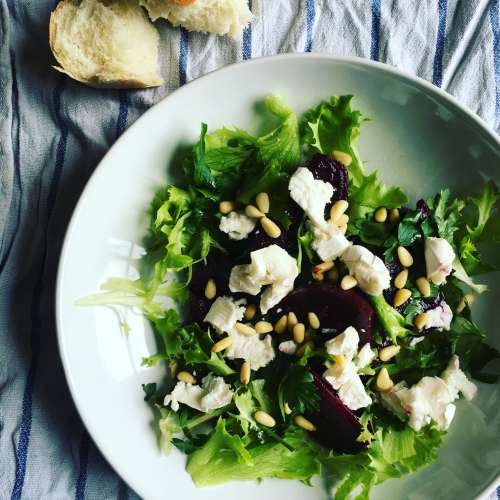
Roast beetroot, goat’s cheese and pine kernel salad

Food & drink
Roast beetroot, goat’s cheese and pine kernel salad

It’s the first day of the year that I’ve had to rid the car windscreen of ice. The temperature has plummeted in the last few days, and this morning, I dropped a big piece of beef brisket into a slow cooker to compensate.

There are a couple of things to deal with yet, the last hangovers of the early autumn, a few things that cling to summer but don’t feel quite so out-of-place in the cold.

One is this salad of roasted beetroot, goat’s cheese and pine nuts, a bowl full of big, robust flavours that neatly straddle the seasons.

Beetroot are good at the moment, but they won’t be around for long. The big bunches on the market stalls are the last of the season, but they keep well in the fridge as long as you chop the leaves off and use them first.

For this salad, the unpeeled-but-scrubbed beetroot is roasted, in a tray covered tightly with aluminum foil, a few sprigs of thyme, an orange, quartered but unpeeled, a few cloves of garlic, a good drizzle of olive oil and slightly too much salt and pepper for company. Use about half a kilo of beetroot, but more won’t hurt – beetroot roasted in foil with some punchy flavours is a good thing to have around in the fridge, and can make for a good mid-week lunch with some bread, so it’s worth making double here.

More…

Nikkei: Japanese Food the South American Way, by Luiz Hara

Books
Nikkei: Japanese Food the South American Way, by Luiz Hara post image

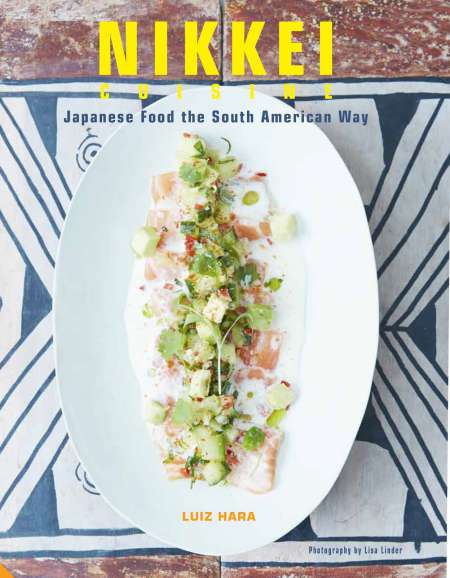
There’s a paragraph in the introduction to Nikkei Cuisine: Japanese Food the South American Way in which Luiz Hara discusses The ‘F’ Word … fusion.

Fusion food often gets a bad press, the result of too many car-crash combinations of flavours. If it can be done, it doesn’t necessarily mean that it should be done, but many chefs haven’t heeded this simple maxim in the past and the results have been, well, disastrous.

Hara’s hesitation and desire to bring this issue up right at the start is understandable, for this is a book of fusion food – it sits neatly in that place where two distinct culinary traditions collide – but it has a clear edge in that the Nikkei tradition of cooking is so well-developed and established that it’s moved far the latest brain wave from some upstart chef in a new hipster noodle type place somewhere in Manchester. Nikkei is no mere fad.

‘Nikkei’ is the name given to the food cooked by Japanese people as they migrate around the world. A good number of Japanese settled in South America from about 1872 onwards, and they found a food tradition very different to the washoku, or traditional Japanese, cuisine they’d left behind. Importing Japanese ingredients, many of which are pretty esoteric and difficult to get hold of in a modern Western city, let alone Victorian era South America, was hard, so people had to improvise, using whatever was available to them. This led to a gradual blending of styles and techniques, with Japanese flavours sneaking into South American dishes, and South American ingredients deployed as substitutes for the ‘proper’ Japanese ones.

[continue reading…]