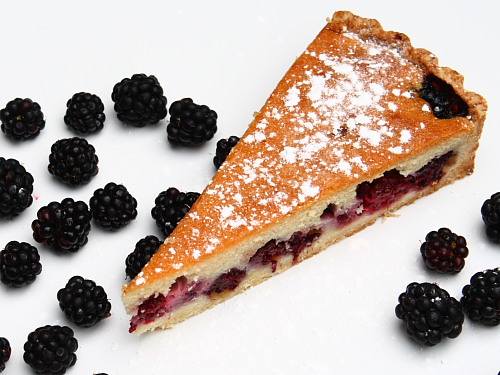
Crostata di more, or Italian blackberry tart

Food & drink
Blackberry torte

Every year, I make the mistake of going blackberry picking in shorts.

The thorns on the blackberry canes are fine – I can avoid those – it’s the nettles that always seem to grow around them that get me every time, but foraging food isn’t meant to be easy.

You should put a bit of effort in if you’re going to get something for free, and maybe experience a touch of outright pain as part of the deal, too.

The blackberries are worth it in the end.  This year, my favourite bushes, in an undisclosed secret location, were weighed down with a good mix of large, plump berries, juicy and mild in flavour, and much smaller, tart berries, hidden away under the top layer of leaves.  Perfect fruit.

This Italian blackberry tart is a great place to start making inroads into your haul.  It uses a fairly standard shortcrust base, packed with berries and topped with frangipane.  The basic components and principles are endlessly versatile and will accommodate most types of fruit.  Dried apricots are sensational, as are apples, plums and cherries.  Pears are a little…whatever.

The pastry case needs to be started the day before.  Actually, it needs to be frozen solid, so you can make it weeks in advance if you’re particularly organised.  Cooking a pastry case from frozen pretty much guarantees no shrinking.

This method makes two sweet short crust tart cases, and it’s from Jamie Oliver’s first book, The Naked Chef.

Blend 250g of butter, 200g of icing sugar and a pinch of salt in a food processor until the mixture is light and a little fluffy.  Pulse in 500g of plain flour and four egg yolks. You’re aiming for a mixture that looks like – yes, you’ve guessed it – fine breadcrumbs.  I normally scrape the creamed together butter and sugar into a very large bowl and rub the flour and egg yolks in by hand, because my food processor isn’t quite big enough.

Add a splash of milk and bring the dough together, then mould it into a fat cylinder, wrap it in cling film and refrigerate it for at least an hour.  The trick here is not to overwork the dough.
More this way…

How to make a Scotch egg that’s a cut above the rest

Food & drink
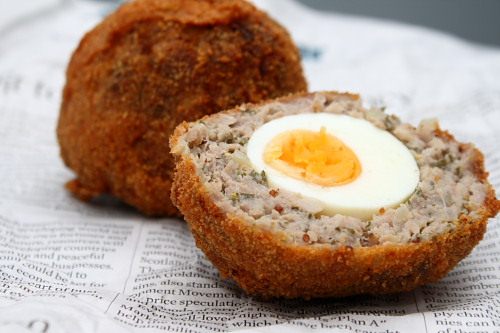
How to make a Scotch egg using a simple recipe

I don’t think I’d be doing the humble Scotch egg an injustice to suggest that it’s got a bad reputation.

The true horror of the mass produced Scotch egg, mainstay of the wet British picnic, can be found in any supermarket in the land.  Dull, grey, under seasoned meat hugging an overcooked egg, the whole lot coated in fluorescent breadcrumbs that suggest some sort of food additive derived from raw nuclear waste.

At their worst, as they so often are, the Scotch egg is an abomination, a wholehearted and shamefaced offence against all that’s good in the world of food.  I’ve eaten Scotch eggs that would have been perfectly usable in one of those floodlit cricket matches where they need a ball that can be seen easily.

So, does it always have to be this way?  No, you’ve probably guessed by now that it doesn’t.  As with many mass produced things, you can either make it in bulk, or you can not bother and make it freshly and properly in small batches.

If you break it down, a Scotch egg is nothing more than a hard boiled egg wrapped in pork, coated in breadcrumbs and deep fried.  There’s very little not to like there. 

Wikipedia Extensive research tells us that the Scotch egg was probably invented by posh food shop Fortnum & Mason in 1738 as a novel way of shoehorning both eggs and sausage meat into a luxury picnic hamper.  Whether this is true or not is debatable, but the inspiration may have come from a far older Indian dish, where eggs are coated in heavily spiced minced lamb and braised in a yoghurt based sauce.

Eggs coated in heavily spiced minced lamb?  That’s my kinda dish. More on that soon.

There’s no real clue out there about why this not particularly Scottish snack is called a Scotch egg.  It just is.

To make your own, you need to start in the middle.

Recipe next…

Hix Oyster & Chop House, Mark Hix

Books
Hix Oyster & Chop House, Mark Hix post image

Mark Hix runs a clutch of restaurants in London and another one in the coastal town of Lyme Regis in Dorset. With his food, Hix wanted to rekindle the old London chop houses – restaurants that flourished during the 1800s that were ‘civilised places to eat big chunks of meat.’

A constant theme on Hix’s menus, alongside the oysters, has been prime cuts of meat, on the bone, cooked traditionally.

This direction is followed through into Hix Oyster & Chop House.

The meat section of the book starts with a full twenty-five pages of photographs and descriptions of a multitude of different cuts of meat, with notes on their particular characteristics and peculiarities.

It’s the sort of introduction to a chapter that wouldn’t be out of place in Hugh Fearnley-Whitingstall’s fine Meat book.

There’s a similarly detailed dozen page introduction to the chapter on oysters, covering the different varieties available in the waters around the British Isles, and ending with a step-by-step guide to shucking oysters. Despite the guide, I think that’s something best left to somebody else, preferably somebody wearing a chainmail glove.

More this way…

Churros, or Spanish doughnuts

Food & drink
Churros, or Spanish doughnuts post image

We spent a week in Barcelona recently, and walking around the city, you notice little bars and cafes everywhere selling hot chocolate with long, piped doughnuts, ribbons of fried batter coated in sugar and sold in cones or paper bags.

Ethan latched onto the idea, as kids do, that he wanted to try churros, but for one reason or another, we were never near a suitable place to buy some when the craving struck.  We made a determined effort one day to actually go out and find churros, before realising that Sunday afternoon wasn’t the best time to go looking…

So here’s a recipe for home-made churros, cooked almost entirely to stop Ethan moaning on about going all the way to Spain and not getting any churros.

Bring 250ml of water to the boil and add 75g of unsalted butter, cut into inexact cubes.  The butter will melt quickly, and when it has, take the water off the heat and let it cool for a minute.

Mix half a teaspoon of baking powder and a good pinch of salt into 200g of plain flour and add this to the water and butter a spoon at a time, stirring each spoonful in until you get a smooth, very thick batter, the type that you could take a chunk out of with a spoon.  You may need to adjust the amount of flour or water to get the right consistency…my mixture was far too thick, and adding more water made the whole thing look distinctly unpromising.  A lot of stirring and mixing got things back on track, so do persevere even if you think you’ve made a hash of things.

Let the batter cool for a minute or two and then add a large egg and stir until it’s completely amalgamated.

The finished batter should be quite thick, more like a very loose dough. Another photo this way…

Tod man mu, or spicy Thai pork meatballs

Food & drink
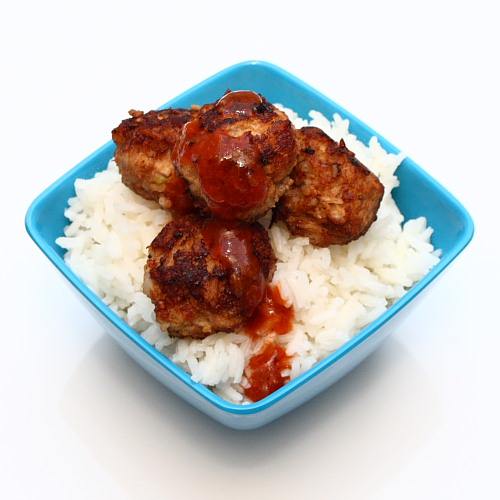
Fiery, chili flavoured Thai pork meatballs

It’s strange that most cuisines have some sort of variation on the humble meatball, and I think it’s a little sad that we Brits don’t think more highly of them.  There’s a world of things that can be done with this method.

This is the Thai version. Tod man mu are heavily spiced little pork meatballs, with a fiery chili kick and a rich seam of citrus flavours.

They’re utterly delicious.

This recipe came via Twitter, from @joolscyprien, who recommends eating them with a beer, mainly to quench the vicious chili , I suppose.

They’re very easy to make – more of an assembly job than anything else – and if you’ve ever made an Italian meatball, you’ll know what you’re doing.

Start with about half a kilo of the best quality minced pork you can find, then add a good handful each of of dried coconut and cooked jasmine rice, half a tin of coconut milk, two and a half to three generous tablespoons of Thai red curry paste, the juice and zest of a lime, four or five finely chopped kaffir lime leaves, a big splash of nam pla, or fish sauce and as much chilli powder as you think you can stomach.

You may or may not need to add an egg to bind the mixture together.

More this way…