How to make boudin noir

Food & drink
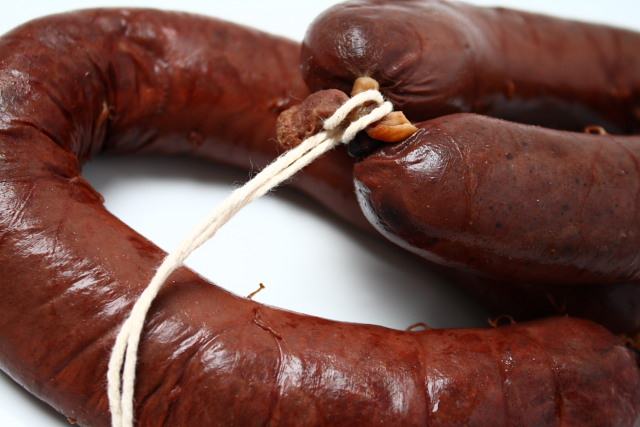
How to make French Boudin Noir, or black pudding

You either love blood puddings and sausages, or you hate them.

I’ve yet to find anybody who’s simply ambivalent.

Sitting on the fence just doesn’t seem to apply here.

There are many different versions of blood sausage – the traditional British black pudding contains oats to thicken it, the Spanish Morcella has rice, and this French boudin noir dispenses with all such frivolities and just sticks to the main event.

Blood.

It’s a hardcore blood sausage.  Yes, there’s a bit of apple in there, but chopped up so finely that it gets lost in the mix.

The French don’t want to detract from the blood, you see.

Now, a little more about blood, pig’s blood to be precise.

It’s very, very unlikely that you’ll be able to get hold of any fresh blood, unless you run an abattoir or keep your own pigs.  In some parts (or all parts, I’m not sure…) of the US, the sale of pig’s blood is illegal.  I’m not sure I understand quite why, but it is.  In other places, it’s just very hard to get hold of.

The best course of action is to use dried blood, which is actually a very good product, and used as the base of most commercial black pudding and blood sausage anyway. Dried blood just needs reconstituting with water (six parts water to one part blood, or five to one if you’re feeling particularly ghoulish and want a slightly thicker mix).

For a French boudin, use water, but for a British black pudding, beer would be good.

Proper beer, mind.

If the first ingredient sourcing problem you had was blood, the second will be fat.

Most butchers will be a little reluctant to sell pork back fat on its own.  It’s simple, really…the back fat wraps around many of the pig’s prime cuts and does a very fine job of protecting and basting the meat as it roasts.

And then there’s the small matter of crackling…

You might get lucky, and find a butcher with a bit to spare, but you’ll have to ask around.  I had to ring half a dozen butchers before finding one that would give me any back fat at all, and even then, I had to drive for twenty minutes to pick it up.

Don’t feel sorry for me, though, that bloke’s pork pies were amazing.

OK, so you’ve got back fat.

You need hog casings now.

Hog casings are a kind of thick sausage skin made from cow intestines.  You’ll be able to find them online.

The hog casings, about three metres of them, need soaking in water and rinsing thoroughly to remove the salt they’re preserved in.  The rinsing is easier if the casings are cut into sixty centimetre lengths first.

So, everything’s set.  The rest of the things you need are fairly common or garden…
More this way…

Keevil & Keevil, meat through the post

Food & drink
Keevil & Keevil online butchers, Smithfield Market, London

Years ago, walk down any British town’s high street, and you’d find a clutch of entirely predictable shops.

A baker, a greengrocer, maybe a fishmonger if you were lucky, and a butcher.

The explosive growth of the supermarket and our hunger for the convenience of shopping for everything under one roof with a big car park outside put paid to many of these independents.

True, many still remain, but when I drive past the row of shops where I grew up, in the newsagents, it’s hard not to notice that the baker, the hardware store, the greengrocer and the butcher have all gone, with our old newsagent a shadow of its former self and only an always mediocre fish and chip shop remaining intact.

For the people of that area, the ability to shop at a local butcher has gone, swallowed up by the enormous Morrison’s not far down the road.

This leaves a gap in the market.  Of course, supermarkets do their best, but they’re not artisans, and sometimes people want a little more for their money… not necessarily in quantity, but in quality and difference.

It’s into this gap that companies like Keevil & Keevil have neatly slipped.

Keevil & Keevil are a famous name in British butchery.  They’re the oldest trader at London’s Smithfield Market, and parts of their organisation date back to 1794.  As a wholesaler, Keevil & Keevil supply some of the best butchers in London, and their Internet shop is an offshoot of the retail store at Smithfield.

One of Keevil & Keevil’s strengths is unusual meats, so there’s plenty of game and charcuterie, as well as wagyu beef, a range of black and white puddings, and plenty of haggis.  The only thing I’d take issue with is the presence of a vegetarian haggis.

I’m sure it’s nice, but, well, really?  The whole point of a haggis is that it’s made up of odd bits, not carrots and swedes…

Orders are delivered in substantial, heavily insulated boxes, packed with ice and polystyrene.  My order was delivered just after I’d set off for work and sat untouched in a reasonably warm dining room all day.  When I opened it up in the evening, everything was still fridge cold and in perfect nick.

More below…

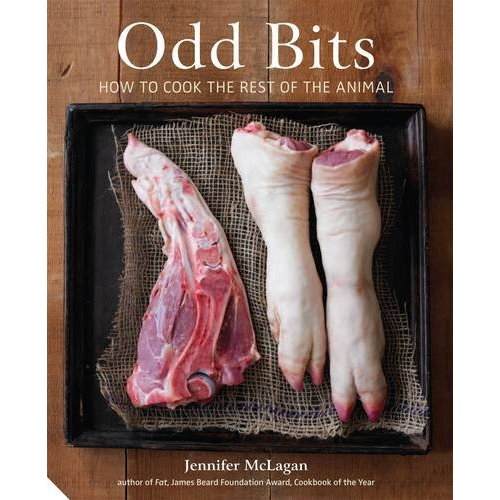
Odd Bits: How to Cook the Rest of the Animal, by Jennifer McLagan

Books
Odd Bits: How to Cook the Rest of the Animal, by Jennifer McLagan

Go into any supermarket, and most butchers, and there’ll be shelves full of neatly butchered meat, prize cuts of rump, sirloin, tenderloin…the premium parts of the animal.

What’s missing is the rest of the beast, all the other parts that don’t make up the standardised, easy to handle, easy to cook cuts that people so predictably buy.  There might be a few bits of liver or a couple of kidneys, but that still doesn’t account for the whole animal.

Where’s the rest?

The simple answer is that it isn’t there because there’s no demand for it, and as industrialised farming has become so good at producing prime cuts at ever cheaper prices, there’s no wonder that demand for offal and other offcuts has plummeted.

Why have trotters when you can have chops, we’re told, and our eating and buying habits have changed accordingly.

I’ve written a few times about strange parts, and those posts have always done very well, so maybe all is not lost.  Maybe there’s still a residual interest out there, and it’s this residual interest that Jennifer McLagan taps into in her book, Odd Bits: How to Cook the Rest of the Animal.

McLagan’s premise is that eating the odd bits isn’t that odd at all, and she goes to some length in a captivating introductory essay to prove so, noting that prehistoric hunters would always eat their quarry’s heart and brain first, followed by the most perishable parts next.

The ancient Greeks delighted in eating splancha, the animal viscera.  There was less of it, so it was more precious than the animal’s meat, and merited respect and special handling.  In Greece, kokoresti, skewered lamb offal wrapped with intestines, remains a popular dish.  In France, these odd bits are still called les parties nobles, the “noble pieces” or “prized parts”.

More…

Create, Leeds

Eating out
Create, Leeds

Rob said that he’d find us a restaurant.

Normally, that’s a good thing, but this time he suggested this new place in Leeds that’s run by his old boss from his time at Harvey Nicks.  He described it as a bit relaxed, with plastic tables and chairs.

Plastic tables and chairs weren’t what many of us had in mind, but I knew where he meant, and that there would be nothing of the sort, so I helped string people along, letting them believe we were off to some transport caff in a rough part of Leeds, like that one where the losers go at the end of The Apprentice.

After all, it wouldn’t be the first time that’s happened.

So, much groaning, some complaining about driving the long way round the ring road and a scramble to find a parking spot later, we turned up at Create on the edge of Leeds’ banking quarter.

It’s fair to say that the plastic chair description is factually correct  – there were indeed chairs made of plastic – but not the white garden furniture some of us were expecting, much to their relief.

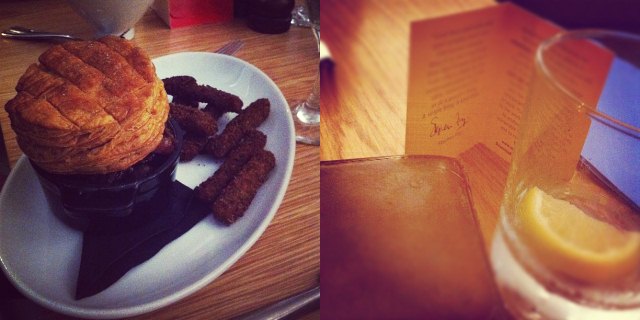
Create’s dining hall is open and airy.  It’s bright and colourful, with huge photos on the walls and an open plan kitchen that’s captivating to watch.  It has a friendly, relaxed and welcoming edge to it, with staff to match.

It’s probably worth describing a little more about Create and what it is at this point, before talking about the food, because it’s mission and reason for being underpins everything.

Create describes itself as a ‘for more than profit’ company, and the restaurant in Leeds is really only the showpiece for a much bigger enterprise that provides training opportunities and jobs for people who’ve been left homeless, marginalised or vulnerable through a series of employment academies across the North of England that focus on developing people’s skills whilst delivering a comprehensive outside catering offering.  Create offers ‘a future to people who want a hand up not a handout’.

It’s about helping people to help themselves, and giving them the skills to develop a sustainable future for themselves, and on the evidence of what we had to eat last night, they’re doing an absolutely magnificent job.

The kitchen in the Leeds restaurant is led by an experienced chef under the eye of Executive Chef Richard Walton-Allen, ex of Harvey Nichols, but the brigade have all come through Create’s training and ranks, and I don’t think I could be more enthusiastic about their food.

It’s simply exceptional.

More below…

Slow-cooked beef in stout or porter

Food & drink
Shin beef in beer

Right, confession time.

This was meant to be a Generic Lazy Blog Post.

Oh come on, you know the sort, especially if you write a blog yourself.  Sometimes us bloggers hit a brick wall and just don’t know what to write about.  We just scratch and scrabble around for something vaguely interesting to cook or write about, but you can tell that there’s no heart in it.

You can spot this type of post a mile off.

Often, they involve infographics or start with ‘some random person sent me this list of questions, and I’m about to bore you with the answers’…

Some people plan for this sort of crisis, storing up a couple of posts for a rainy day, honed and perfected over months and months, just sitting there ready to push the button at times of great existential writing angst, just to tide things over until the doom of writer’s block lifts.

I’m not one of those writers.  I used to be, but I ran out of Emergency Posts ages ago.

So, this was supposed to be something quick and simple to kick-start my writing and cooking brain again after a couple of weeks of being otherwise occupied.

I often use cooking as a way of creating some space in my life, as a way of relaxing and taking stock of things.  There have been many times where silently plotting a new curry recipe, for example, has dragged me through the shittest of days.

I know that, even if things fall apart, I can still knock out a decent bit of North Indian fare in the evening, and sometimes, that’s all that matters.

Today was a little different, though.  Today was about the simplest type of cooking, a dish of simple ingredients cooked in a simple way, with nothing more than time needed to bring it together.  A dish that, if the kitchen is the heart of the house, became the soul of the kitchen as it bubbled and simmered for an afternoon on the hob.

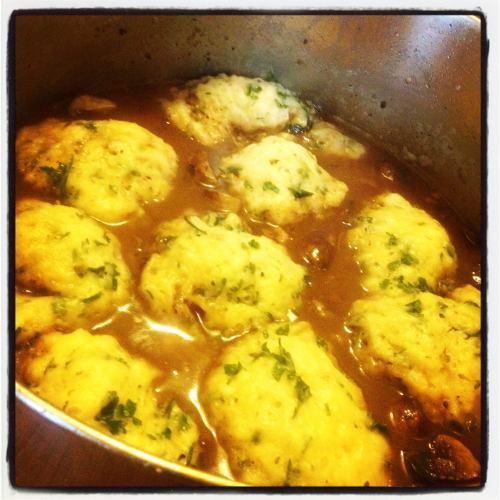
So, beef, slow cooked in stout or porter, with dumplings.

[continue reading…]