How much for that turkey?

Food politics
What makes a turkey good, and how to buy one.

The annual task of sourcing the Christmas Day turkey normally falls to my brother, who being in the trade, knows what he’s looking for and where to get it.

Sourcing the turkey and picking it up are separate tasks, and the job of actually transporting Rob’s carefully hunted prize birds usually falls to Dad.

Last year, things went a bit awry.

Dad decided that a Christmas Eve drive to a far away butcher was too much trouble.

Parking, you see.

Really, he was just getting on a bit, and didn’t relish the prospect of carrying three large turkeys any distance at all, even just from the shop to the car park round the corner.

So, he began enthusing about these apparently incredible turkeys from a butcher close to the swimming pool he used.

Top quality, he kept saying.

The absolute business.

Dad, being Dad, didn’t bother to ask how much before ordering (I mean, really, who doesn’t find out the price first?), so the cost come Christmas Eve was quite the shock, but we got a perfectly good bird each, which came nicely boxed, with cooking instructions on a glossy leaflet, a complimentary sprig of rosemary and a certificate.

That’s right…a certificate.

My turkey came with a certificate to prove its ‘authenticity’.

We paid handsomely for all that marketing, all of that presentation and ‘added value’.

It all made me wonder how much I’d paid for ‘turkey’ and how much I’d paid for ‘marketing guff’.

The turkey is such a big part of Christmas – literally and figuratively – and it’s right to want to do a good job, to push the boat out a little, but, as we learnt in slightly awkward retrospect, there are good deals to be had if you know a thing or two about how turkeys are raised and go armed with a couple of good questions for your butcher.

The first thing to know is that a bird doesn’t need a certificate or a fancy box and a hefty price tag to be good.

Whether a turkey is good or not is dependent on how it was raised, and how it lived its life, and that’s true of all meat and fish.

Look for a bird that’s been grown in a small flock, free-range, hatched in June or July so that it’s slightly older and more mature than it’s intensively reared cousins come December.  A bird that’s spent more time growing will be more flavoursome.

That longer growing season is a commitment on the part of the producer, though.  More time means more feed, and more cost.  A farmer will only do this if he or she is bothered about quality, which is all they should be bothered about.

More below…

Tasting India, by Christine Manfield

Books
Christine Manfield’s Tasting India

There was a piece in The Guardian this weekend that tried to divide cookbooks into two clear categories – ‘lifestyle’ books and ‘instructional’ books.

Most of the celeb chef fodder falls clearly into the ‘lifestyle’ category, along with many more serious books, such as Jennifer McLagan’s book about offal.  I wrote about that one the other week.  Now, there’s a book that needs some lifestyle commitment.

On the other side of the fence are more ‘instructional’ volumes, the ones you reach for when you need to know how to get something done.

On my shelves, the ‘how do I do that?’ book is Delia Smith’s Complete Cookery Course, just as it is on tens of thousands of shelves across Britain.  Not fashionable, not showy, but essential for understanding the mechanics of everyday cooking.

Few books cross this divide, but Christine Manfield’s beautiful Tasting India does.

It’s has the size and heft of a glossy coffee table book, and that, in many senses, is exactly what it is, but unlike others of the genre, it isn’t a flimsy, unsubstantial tome packed full of gorgeous photographs and nothing else.

Manfield’s book is a cookbook, and a fine one at that.

Tasting India is set out like a travelogue, and it’s clear that Manfield has traveled and eaten widely in the sub-continent.  The book’s journey starts in Darjeeling and moves through the Himalayas, Rajasthan, Varanasi, the capital of Delhi, and Tamil Nadu before moving south to the coconut-lined shores of Kerala and Goa, ending in the mega-city of Mumbai.

A book of this size and breadth demonstrates the richness and variety of Indian cuisine.  The Anglicised and bastardised curries we’re used to in our local Indian restaurants, or more likely Pakistani restaurants, at least around Yorkshire,  is only a narrow view of the rich tapestry of Indian food.

More….

Apple bread, baking for cold weather

Food & drink
Apple bread, from Roast Figs, Sugar Snow: Food to Warm the Soul by Diana Henry

It’s nearly December, so all the apples are in and off the trees now.  That leaves an annual problem…dealing with gluts.

Luckily, I don’t have any gluts to deal with, but I do have friends who need to deal with theirs, leading to a slight over-abundance of Bramley apples.  Apple pie? Too predictable.  Baked apples? Nobody likes baked apples, really, do they?

How about baking a few into some bread?

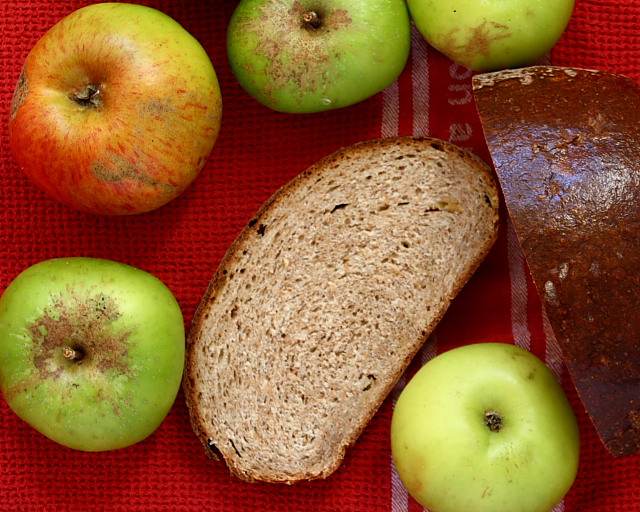
This recipe calls for two different types of apple – a tart Bramley, stewed down so that it disappears into the dough, and a sweeter Braeburn, cut into chunks to give the bread some apple bite.

The Braeburns, three of, need peeling, coring and cutting up into one centimetre dice before being fried in a good knob of butter until they start to brown and caramelise.

The Bramleys, a pair of, should be similarly peeled, cored and sliced into thin strips, then simmered in about 100ml of water until they start to dissolve into a rich purée.

Weigh out 450g of wholemeal flour and 225g of strong white flour, and add a couple of teaspoons of salt, a 7g sachet of dried instant yeast and 50g of caster sugar to the bowl.

More below…

Roast Figs, Sugar Snow: Food to Warm the Soul, by Diana Henry

Books
Roast Figs, Sugar Snow: Food to Warm the Soul, by Diana Henry

Hunger makes beans taste like almonds – Italian folk saying

It was cold today.

That feeling of winter has been creeping in for a few weeks now, the leaves piling up and swirling around the bottom of trees and against walls, things turning brown, dying, hibernating.

It felt like winter, and I’ve started to cook winter food.  Tonight, we had parsnips for the first time this season, fried in butter with coriander, cardamom and chilli flakes, finished in the oven until crisp and eaten with a simple piece of grilled chicken.  There were big flavours, but warming and comforting ones…creamy parsnips and cutting chilli.  Food that matches the weather.

Diana Henry’s Roast Figs, Sugar Snow: Food to Warm the Soul fits this feeling perfectly.  Her book is a collection of recipes that relies on the tastes and flavours of winter in cold places, places where winters are hard, where the environment changes the way people cook and eat.

Life slows down and so does cooking.  Cold-weather dishes undergo slow transformations: alchemy takes place as meat and root vegetables, through careful handling and gentle heat, become an unctuous stew, a dish far greater than the sum of its parts.  The techniques employed in the kitchen fug the windows and seal you in, and you find you want different foods.  You can’t argue with your body as it craves potatoes and pulses: the winter appetite is about survival.

More…

eightpointnine.com’s personalised coffee

Food & drink
eight point nine’s personalised coffee


One of the key things about coffee is freshness.

It’s the reason that any coffee shop worth its salt grinds their own beans, with the very best grinding small quantities very regularly.

At home, it’s difficult to get a decent grind out of most domestic grinders….blade grinders just obliterate the beans, and they do that unevenly, domestic burr grinders are better but still leave the grind too coarse in my experience, OK for a filter, but no good for espresso.

Pre-packed ground coffee is the best option for most people, but there’s a trade-off there…the wonders of modern packaging might keep the ground coffee inside in decent enough nick, but by the time it ends up in your measuring spoon, it could be months old.  And in coffee terms, that’s not good.  Not good at all.

eightpointnine have come up with a neat little solution to this problem…on demand blends.

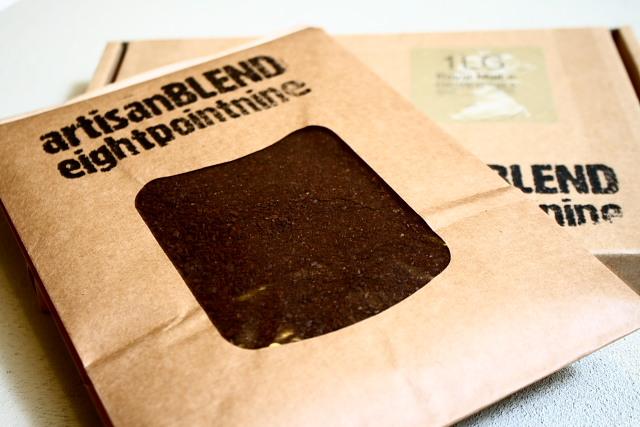
The idea is that coffee is blended, ground to your needs, and personalised to your particular style.  The coffee arrives in the past flat-packed in a thin box designed to go through a letterbox.  A quick shake of the bag in the box snaps it back into shape.

The ‘personalised to your particular style part’ is interesting. eightpointnine’s website lets you blend a bag of coffee just the way you like it by adjusting a couple of sliders to set the flavours and body.  This translates into a custom blend that’s ground to your order.

The real power of this is that each bag could be different – it’s a great way of exploring the complexities and subtleties of coffee.

More…