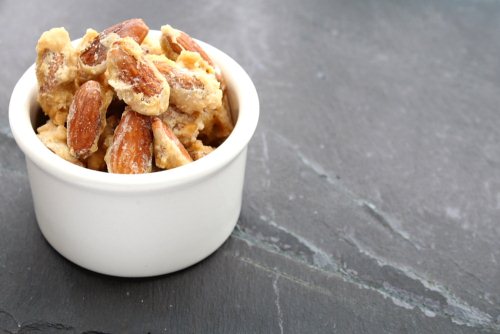
The list of ingredients here is impressively short, but the technique is fiendishly difficult and needs a lot of concentration, good timing and, inevitably, a few botched attempts before you get it right.
It’s worth persevering, though.
Almonds coated in a crust of crystallised sugar?
What could be better than that?
Put 155g of almonds and 230g of golden caster sugar into a small frying pan with a heavy base and add about 250ml of water.
Stir and heat over a medium to high heat until the sugar dissolves and the mixture starts to bubble and thicken. This will take about eight minutes or so.
Eventually, the bubbles will become bigger and slower to burst. At this point, turn the heat down and stir for another minute until the mixture turns white and frothy.
Read more…

The coincidence of a week in Barcelona and a publisher sending me a copy of Frank Camorra’s staggering Movida Rustica cookbook has left me cooking a lot of Spanish food.
I make no apologies for this, but warn that it may continue for a while yet.
Movida Rustica is three hundred and sixty-eight pages long. That’s a lot of recipes.
These biscuits, alfajores, are a throw back to the Moorish settlement of Spain. They’re a typically Arabic sweetmeat, famous in Andalusia, and most prominently, in Cadiz. There are many variations across the Spanish world, but the basic alfajore consists of flour, honey, almonds and spices.
First, toast 250g of flour, spread thinly over a pair of large baking trays in a hot oven for twelve to fifteen minutes or until the flour is a rich golden colour and begins to smell nutty. At the same time, roast some blanched almonds – 125g – on another baking tray for eight to ten minutes or until they start to turn golden.
When the flour and almonds have cooled a little, tip the flour into a mixing bowl and process the nuts in a food processor or blender until they’re fairly finely chopped.
[continue reading…]

Britain’s new coalition government is rumoured to be considering scrapping the Food Standards Agency, the non-ministerial government department responsible for public health in relation to food. Officially, the FSA is ‘under review’, which is usually a process that can only really end in one way’.
The FSA’s duties would be absorbed by the Department of Health, which would take responsibility for public health and by the Department for the Environment, Food and Rural Affairs, which would take over regulatory functions, including food safety and hygiene.
There’s a clear need to cut costs in the current economic environment, but is the removal of a body responsible for providing a focal point for food related public health and regulation a good idea, even if it has been in the past, in the succinct words of one Tweeter ‘a bit rubbish’?
The biggest issue I see is not with the FSA, but with the influence wielded by a small number of very large food producers and retailers. The FSA has fought long and hard to see the introduction of a traffic light system on food packaging, which would act as a way of highlighting unhealthy foods more easily for the consumer. The intention is clearly good, but the implementation has been hampered at very step of the way, faced down by widespread reluctance from an industry that sees self regulation as an easier option.
[continue reading…]

It’s always nice to receive a gift, even more so when it arrives unexpectedly.
This recipe came on the side of the paper bag that held my takeaway from the Aagrah in Shipley.
It’s a nice little gimmick, and a welcome one given that the Aagrah stands head and shoulders above all other Indian restaurants in Bradford and Shipley.
Their food is simply excellent, so having one of their recipes fall into my hands is a bit like a mini Christmas for me.
As with all Indian cooking, the list of ingredients is about a mile long, but the method isn’t complicated and the dish comes together quite quickly.
Start by grinding some spices in a blender – the seeds from two black cardamom pods, a medium cinnamon stick, five cloves, a dessert spoon of coriander seeds, half a dessert spoon each of cumin seeds and black cumin seeds, a dessert spoon of poppy seeds, six black peppercorns, half a dessert spoon of fenugreek leaves (a small handful, really) and three bay leaves.
Read more…

You ordered something that sounded tasty.
The waiter arrives with your meal, puts it down in front of you and you start eating.
You realise quickly that the expected juicy steak has been grilled to within an inch of total carbonation, or that the chicken is salmonella pink in the middle.
The waiter reappears, a smile on his face. He asks if everything is OK with your meal. Maybe there’s a slight hint of nervousness in his voice that betrays the fact that he knows that the chef is nearly useless and the meal under discussion is terrible, but he has to ask…
At a distance, and safely hidden behind a laptop, it’s easy to say that you should be politely assertive and tell the waiter exactly what’s wrong with your food, and ask for it to be rectified.
But does that always happen?
Do you not sometimes just mumble something vaguely positive, carry on eating and feel like a fool?
What do you do?
Read The Rules below…
